
Background on Generation Z and Their Demands
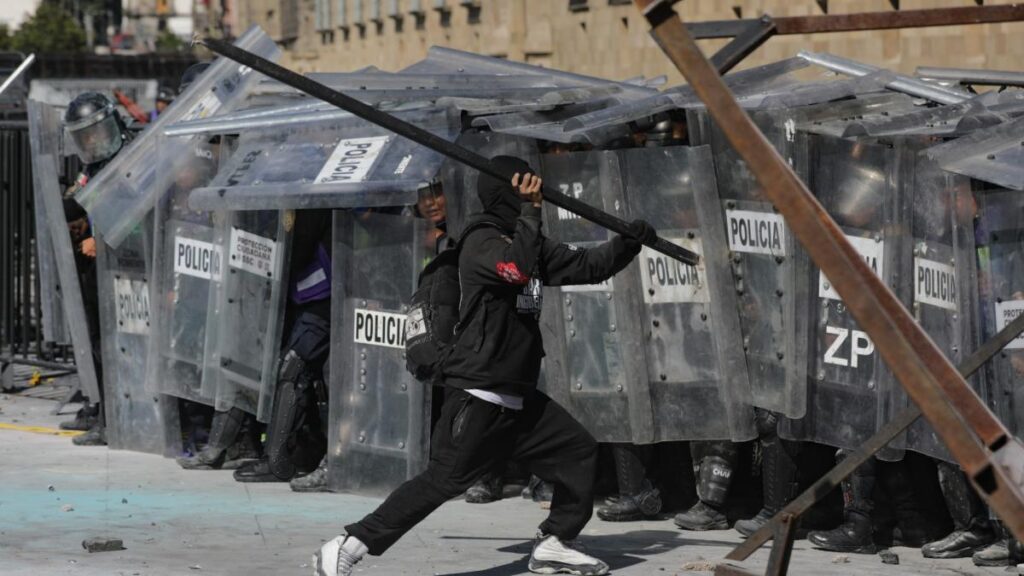
Generation Z, a group of young individuals advocating for enhanced security and better opportunities, organized a march in Mexico City to voice their concerns. The peaceful demonstration, which started at the Ángel de la Independencia, took a violent turn when a group of hooded individuals tore down protective barriers around the National Palace, leading to clashes with security forces.
Official Responses and Condemnation of Violence
The Mexican federal government, represented by the Secretariat of Government (Segob), and the Mexico City Government strongly condemned the violent acts that transpired during the march. Segob issued a statement rejecting all forms of violence and provocations that threaten people’s lives and well-being.
Mexico City’s government reported that the protest gathered 17,000 participants. However, a group of approximately a thousand hooded individuals instigated chaos by using makeshift explosives, tools, and projectiles against police officers and pedestrians in the Zócalo. This resulted in 60 injured officers at the scene, 40 transported to hospitals, 20 detentions, and 20 administrative offenses.
Key Figures and Their Statements
Claudia Sheinbaum, the president of Mexico City, denounced violence during a public event, emphasizing the importance of peaceful protests. Earlier, she had suggested that the march was “impulsive from abroad” using bots. Yet, numerous young protesters interviewed during the demonstration disputed this claim.
Details of the Incident
As the march approached the Zócalo, a group of about a thousand hooded individuals breached protective barriers around the National Palace using hammers, chains, pliers, and explosives. In response, the capital’s police force formed a human shield to prevent further incursions. Security personnel primarily used fire extinguishers to control fires ignited by the hooded group.
Reactions and Further Measures
Pablo Vázquez Camacho, the Secretary of Security Ciudadana, described the situation as “unacceptable,” stating that organized groups instigated the violence. César Cravioto, the Secretary of Government, accused opposition actors of resorting to vandalism and causing damage to public institutions.
To manage the situation, Mexico City’s government deployed 800 police officers, civil protection personnel, firefighters, Metro and Metrobús staff, and human rights commission representatives. They also established the Base Morelos to monitor real-time developments and deployed 180 members of the Dialogue and Coexistence Group to prevent confrontations.
Nationwide Movement and Cross-Reactions
The Mexico City march was part of a broader national movement with expressions in cities like Monterrey, Guadalajara, Mérida, Puebla, Xalapa, Querétaro, Toluca, and Cuernavaca, as well as Michoacán following the assassination of Uruapan’s mayor, Carlos Manzo.
Although the demonstration began peacefully and inclusively, the hooded group’s intervention escalated tensions. This led to conflicting statements from young protesters, federal authorities, and the Mexico City government regarding the balance between free expression and public safety.
Key Questions and Answers
- Who organized the march? Generation Z, a group of young individuals advocating for enhanced security and better opportunities.
- What were the initial demands of the march? The protesters sought improved security and better opportunities for young people.
- What caused the violence during the march? A group of approximately a thousand hooded individuals instigated chaos by using makeshift explosives, tools, and projectiles against police officers and pedestrians.
- How did authorities respond to the violence? Authorities condemned the violence and deployed security personnel to manage the situation. They also emphasized the importance of peaceful protests.
- What was the scale of injuries and detentions? Over 100 police officers were injured, with 60 treated at the scene and 40 transported to hospitals. Twenty protesters were detained.




