
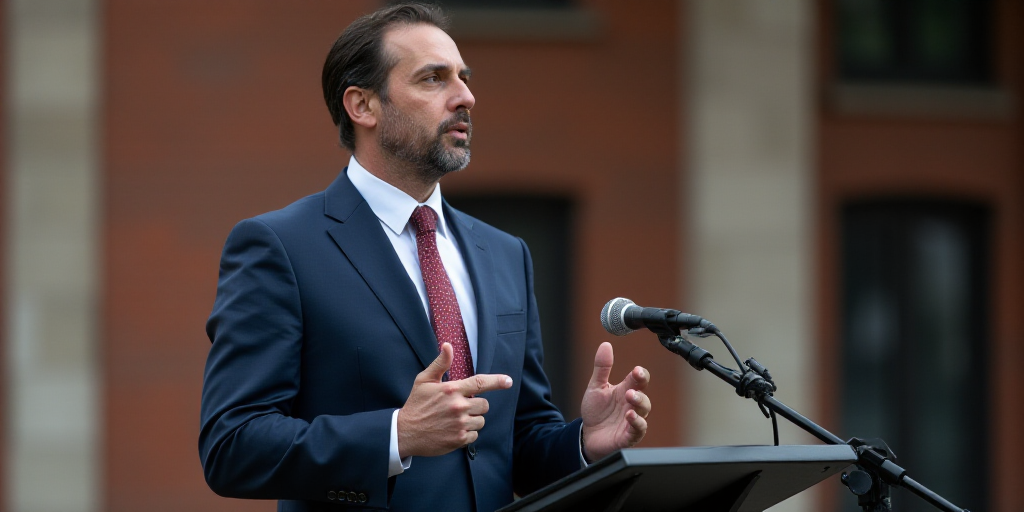
From Unknown to Victor: Mamdani’s Unconventional Path
Zohran Mamdani, a complete unknown ten months before the New York City mayoral elections, emerged as the unexpected winner. He achieved this feat without financial backing or influential supporters, defying all odds.
The Keys to His Success: Authenticity and Strategic Storytelling
Much has been written about the factors contributing to his success: a clear message centered on basic needs, such as freezing rents, providing free bus services, and implementing universal childcare. He mobilized an army of 100,000 volunteers to deliver this message door-to-door to three million households, complemented by a brilliant social media strategy.
However, his success was not solely due to these elements. There was a political strategy built on Mamdani’s authenticity, crafting a specific political narrative.
A Young, Immigrant, Muslim, and Democratic Socialist Candidate
Mamdani’s campaign was grounded in a clear embrace of his unique identity: a young immigrant Muslim (born in Uganda) who identifies as a democratic socialist, a term traditionally taboo in American politics.
Instead of distancing himself from these labels, Mamdani leaned into them to build an authentic persona and craft a believable narrative, thus fostering trust.
Authenticity in politics is often discussed as a personal trait—someone being natural, spontaneous, and genuine. However, authenticity is not merely an informal attitude but a strategic decision that transforms one’s being into a communicative architecture that is deliberately built, nurtured, and maintained.
Mamdani capitalized on this by becoming a sort of social media content creator, using the style characteristic of these platforms to advance his campaign. Short videos, clear and direct language (in multiple languages), interactions with local shop owners, conversations with taxi drivers, interviews or collaborations with influencers—all these elements helped him connect with the everyday experiences and stories of New Yorkers.
Storytelling: Building Narrative in Politics
In politics, there’s nothing left to chance. While a candidate’s personality and authenticity serve as the starting point, there’s also a constructed narrative element.
Storytelling is a tool used in advertising to convey messages and values, in education to teach through morals, and in politics to generate images that solidify concepts and evoke emotions.
As communication politics professor Toni Aira explains in his book Mitólogos, the passion of stories allows for a strong connection with the audience. Consequently, politicians carefully design their projected image to evoke emotions, recall memories, activate deep-seated ideas, and foster adherence.
Nowadays, symbols often replace arguments due to their effectiveness. Thus, what matters is not a politician’s words but the image they project—their “personal myth” before the masses.
The goal is for citizens to connect with politicians passionately, making the politician explain something of interest, entertainment, surprise, understanding, or liking. Most importantly, it should personally engage them. Stories serve as the perfect vehicle for this.
Christian Salmon, a writer and author of books like Storytelling: The Story-Making Machine and Mind-Formatting, asserts that this narrative technique is a mass distraction weapon, using storytelling to persuade and mobilize public opinion.
For Salmon, election campaigns are storytelling duels involving four elements clearly identifiable in Mamdani’s campaign:
- Storyline (central narrative): explaining a story that forms the candidate’s narrative identity. In this case, Mamdani was portrayed as a young outsider with community roots and commitment to accessibility policies representing change and an alternative to the establishment.
- Framing (discursive framework): framing the candidate’s ideological message through consistent language use and creating metaphors. Mamdani’s message was framed around people’s basic needs (living in New York is unaffordable), not abstract economic rhetoric, and used metaphors like “popular power” to give symbolic meaning to collective participation.
- Timing (temporization): embedding the story within the campaign timeline, managing narrative rhythm and tension throughout. Mamdani built momentum as the campaign progressed, transitioning from an “outsider candidate” to “the candidate who can win.” After his victory, he activated his transition website, The Work Starts Now, ensuring the campaign narrative remained connected to his future governance story (continuity).
- Networking (network creation): building a community online and on the ground. Creating an infectious environment capable of capturing public attention. Mamdani achieved this with 100,000 enthusiastic volunteers tasked with generating energy and contagion to mobilize votes and create conversation.
Mamdani’s campaign functioned, as political journalist Makena Kelly described, like a “political fandom”—a community of passionate enthusiasts sharing a deep interest in a specific topic, where Mamdani was not just a candidate but a character with followers creating memes and proactive content. This transformed the campaign into a cultural participatory movement rather than just an electoral one.
Narratives: Not Inherently Good or Bad, but Exist
The use of storytelling, personal and communal narratives, leveraging social networks, and mobilizing culture deviates significantly from the traditional campaign model of posters, rallies, and formal speeches. It brings political campaigns to a realm where image, narrative, and emotional proximity matter as much—or more—than pure ideological discourse.
On the other hand, Christian Salmon points out that we live in a political and social climate where narratives become powerful tools for creating polarization and dividing society into opposing groups. Narratives that reinforce conflicts instead of promoting dialogue, like those embodied by Trumpism.
Therefore, it’s crucial to recognize that seduction and persuasion are neither inherently good nor bad; their impact depends on how they’re used. They can be harnessed positively or for manipulation.
Understanding how narratives shape our worldview is essential for discerning manipulation and, simultaneously, utilizing these tools effectively to communicate persuasively.




