
Economic Pressure from U.S. Policies
The trade and migration policies of former U.S. President Donald Trump have been a significant pressure on Mexico’s economic growth in the recently concluded year and will continue to do so in 2026, according to the Economic Commission for Latin America and the Caribbean (ECLAC).
Mexico’s Projected Growth
ECLAC anticipates that Mexico will maintain low economic dynamism in 2026, with one of the smallest growth rates in the region. This is due to an unfavorable external environment marked by U.S. trade and migration policies.
In 2025, Mexico’s growth is projected at 0.4%, influenced by the weakening domestic demand due to lower remittances and decreased private consumption and investment. For 2026, a growth rate of 1.3% is expected. Despite the anticipated improvement, ECLAC notes that Mexico’s economy remains vulnerable to external shocks from U.S. trade, financial, and migration policies.
Regional Outlook
For the region as a whole, ECLAC, a United Nations-dependent institution, estimates that Gross Domestic Product (GDP) will advance by 2.3%, completing a four-year sequence near this rate, confirming the region’s continued low growth capacity.
Across the continent, variations in this trend are projected. In South America, lower dynamism is expected, dropping from 2.9% in 2025 to 2.4% in 2026, due to reduced economic estimates for Brazil and the normalization of Argentina’s cycle after a significant rebound in the just-concluded year.
In Central America, an expansion of 3.0% is projected from 2.6% in 2025, led by Guatemala, Panama, and the Dominican Republic due to the strength of the services sector, private consumption behavior, and remittance growth.
However, Central America remains highly vulnerable to external shocks due to its structural economic dependence on the U.S. in trade, finance, and migration, as well as exposure to potential adverse effects of climate change, according to ECLAC.
Latin American Countries with Highest and Lowest Growth Projections in 2026
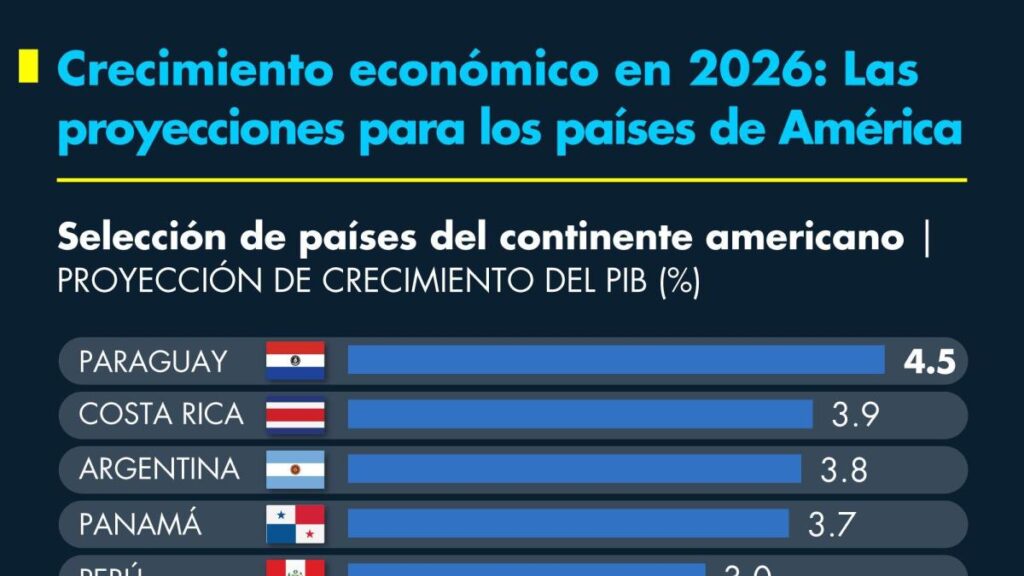
According to ECLAC data, here is the projected economic growth by country in Latin America for 2026, ranked from highest to lowest PIB advance:
- Guyana, 24.0%
- Antigua and Barbuda, 5.0%
- Paraguay, 4.5%
- Costa Rica, 3.9%
- Honduras, 3.9%
- Argentina, 3.8%
- Guatemala, 3.8%
- Panama, 3.7%
- Dominican Republic, 3.6%
- San Vicente and the Grenadines, 3.6%
- El Salvador, 3.4%
- Nicaragua, 3.4%
- Suriname, 3.4%
- Dominica, 3.1%
- Granada, 3.1%
- Peru, 3.0%
- Venezuela, 3.0%
- Santa Lucia, 2.8%
- Colombia, 2.7%
- Belize, 2.6%
- St. Kitts and Nevis, 2.6%
- Chile, 2.2%
- Ecuador, 2.2%
- Barbados, 2.1%
- Uruguay, 2.1%
- Bahamas, 2.0%
- Brazil, 2.0%
- Jamaica, 1.4%
- Mexico, 1.3%
- Trinidad and Tobago, 0.9%
- Bolivia, 0.5%
- Cuba, 0.1%
- Haiti, -1.2%
ECLAC highlights that one of the main pressures on economic growth in 2026 will be private consumption, a crucial component of regional GDP growth, with a projected slowdown from contributing 1.6 to 1.4 percentage points.




