
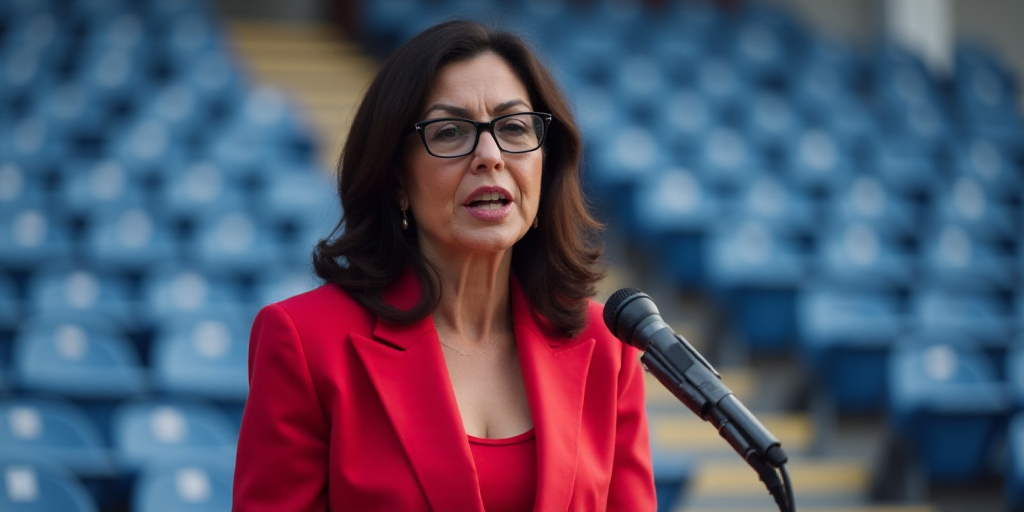
Introduction to Delcy Rodríguez
Delcy Rodríguez, the former Vice President under Nicolás Maduro, has been appointed as the interim president of Venezuela following Maduro’s ousting. Rodríguez, who previously held the position of Vice President until Maduro’s capture during a surprise U.S. military incursion, now faces the challenge of governing without external influence, particularly from U.S. President Donald Trump.
Background on Maduro’s Capture
The U.S. military intervention resulted in the death of numerous individuals, including 55 Cuban and Venezuelan military personnel associated with Maduro’s security detail. Following the intervention, Rodríguez was sworn in with crucial support from the military and other public institutions.
Rodríguez’s Stance on External Influence
In her first public statements, Rodríguez emphasized that she governs independently, without external influence. She stated, “This is a people that does not surrender; we are a people that do not give in,” during a meeting with the economic team broadcast on state television.
“We are governing together with the people. The government of Venezuela rules in our country, and no one else. There is no external agent governing Venezuela; it is the government of Venezuela,” she stressed.
Trump, however, insists that he is “in charge” of Venezuela and hinted at leaving Rodríguez in power temporarily, without considering transferring it to the opposition led by Nobel Peace Prize laureate María Corina Machado.
Trump warned Rodríguez that she would face severe consequences if she “does not do the right thing,” potentially exceeding those faced by Maduro.
Legal Proceedings Against Maduro and His Allies
Maduro and his wife, Cilia Flores, now face U.S. justice for drug trafficking and other charges.
“He’s a violent man who has killed millions of people,” Trump said during a conference with Republican lawmakers.
The Department of Justice removed most references to the alleged “Cartel of the Suns” in the new indictment against Maduro, Flores, his son “Nicolasito,” the Interior Minister, and the leader of the feared Tren de Aragua gang.
Parts of the operation against Maduro were based on designating this supposed narco-trafficking organization as a “clientelism system,” according to reports from El País and The New York Times.
It remains unclear how this change may affect the case against Maduro, who declared himself a “prisoner of war” and pleaded not guilty.
“I am a decent man, I still am the president of my country,” Maduro stated in court before being interrupted by the judge.
Mexican President Claudia Sheinbaum called for a “fair trial” for Maduro, while the United Nations considered that the operation leading to his capture “undermined a fundamental principle of international law.”
Challenges for Rodríguez’s Interim Presidency
Rodríguez must navigate immense pressure from the U.S. and rebuild chavismo without Maduro.
A retired general who held high-ranking positions in the military suggested that Rodríguez would open doors to U.S. oil and mining companies, potentially reestablishing diplomatic relations with Washington, which were severed in 2019.
Simultaneously, she would promote a “political-electoral agenda,” including the release of imprisoned politicians, according to the source.
The interim presidency has a maximum duration of 180 days, after which elections must be called.
“The primary objective is to gain time to consolidate the restructuring and take advantage of Washington’s focus on petroleum-related demands, which will also take time to materialize,” political analyst Mariano de Alba explained.
Rodríguez appointed a new economic czar, vacating her previous role. She retained most of Maduro’s cabinet, with Diosdado Cabello in the Interior Ministry and Vladimir Padrino in Defense as key figures.
“Rodríguez should be very cautious right now,” former U.S. diplomat Brian Naranjo told AFP, who served as deputy chief of mission at the U.S. embassy in Venezuela from 2014 to 2018 before being expelled by Maduro.
“Behind her are two men who would be more than happy to cut her throat and take control,” he added, referring to Cabello and Padrino.
De Alba, however, estimated that “despite internal differences, chavismo has internalized that only through apparent unity do they have a chance of perpetuating power.”
Women’s March and Media Restrictions
The chavismo organized a “Women’s March” to demand Maduro and Flores’ release. Daily protests have been called since Saturday.
Thousands of supporters participated in the demonstrations. Cabello walked alongside the crowd on a major Caracas avenue.
“We are willing to go wherever necessary to defend our president Nicolás Maduro and our first lady,” Sara Rodríguez told AFP. “We are willing to defend this until Maduro returns.”
“The woman representing us now, who assumed the interim presidency, is a revolutionary woman, she’s the best, she’s a woman to trust,” added Sara Fernández, 70.
On Monday, amidst the installation of the new parliament and Rodríguez’s investiture, 14 journalists were detained in Caracas. Most belonged to international media outlets.
Two others were held at the Colombian border, while another correspondent was deported from the Caracas airport, according to the press union’s report.
The political repression in Venezuela cannot be tolerated, declared Albert Ramdin, OAS Secretary General, during an extraordinary session of the Organization of American States.




