
Record-Breaking Revenue in 2025
In comparison to 2024, when revenues were at 5.5 trillion pesos, the growth in 2025 was a remarkable 487 billion pesos, nearly 500 billion pesos, equating to a real increase of 4.8 percent. The federal government reported that revenue observed in 2025 reached 6.045 trillion pesos, surpassing the 5.9 trillion pesos approved in the Income Law, representing a compliance rate of 101.6 percent.
Key Figures and Contributions
Antonio Martínez Dagnino, head of the Mexican Tax Administration Service (SAT), explained that annual revenue growth between 2019 and 2025 has consistently ranged from 350 to 450 billion pesos, with 2025 marking the highest level in this period. He highlighted that customs revenue, comprising import VAT, import IETU, and general import and export taxes, accounted for 27 percent of net tax revenue. This resulted in an increase of 246 billion pesos compared to the previous year, with a real growth rate of 16 percent.
Acknowledging Contributions
Edgar Amador Zamora, Secretary of Finance and Public Credit, recognized the contributions from small, medium, and large taxpayers, emphasizing that without these contributions, it would be impossible to finance the expenditure budget, social programs, or infrastructure projects.
Amador Zamora mentioned that the SAT published a document on January 5 outlining best practices for transparency in audit processes, which will be part of the Master Plan 2026.
He further explained that in case of non-compliance, the SAT will conduct only one audit per taxpayer to provide legal certainty. These reviews will be based on samples of the subject fiscalization parts rather than the entire information set. He assured that the same criteria will be applied across all SAT offices nationwide, with an average resolution time of five business days for individuals and 30 business days for businesses, both below the legal 40-day limit.
Focus on Fiscalization for 2026
Regarding the fiscalization approach for 2026, Amador Zamora stated that the focus will be on closing revenue leaks associated with invoice fraudsters, simulated operations, recurring tax losses, illegal deductions, undeclared income, and those who abuse fiscal incentives, present inconsistent import-export data, undervalue goods, violate non-tariff regulations, fail to pay worker withholdings, operate through tax havens, or request improper refunds.
He added that the projected federal income law for 2026 anticipates a revenue of 6.448 trillion pesos, indicating a nominal increase of 496 billion pesos and real growth of 4.6 percent.
President’s Perspective
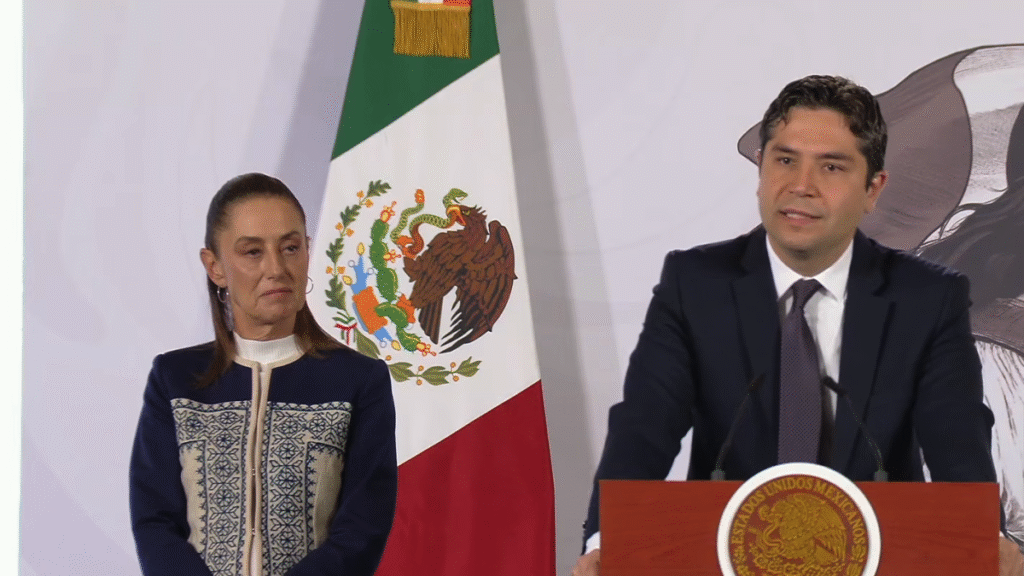
Mexico’s President, Claudia Sheinbaum, emphasized that the revenue collected in the past year was achieved without creating or raising taxes. She pointed out that real growth was accomplished by combating tax evasion and stated that a similar additional amount is planned for 2026, directing the SAT’s efforts primarily towards invoice fraudsters and customs, areas still experiencing resource leaks.
Sheinbaum asserted that “not paying taxes is a form of corruption” and emphasized that the additional income obtained was directed towards welfare programs, public works, health, and education, describing the revenue collection results as “good news” for Mexico’s public finances.
Key Questions and Answers
- What was the revenue growth in 2025 compared to 2024? The revenue grew by nearly 500 billion pesos, equivalent to a real increase of 4.8 percent.
- Who are the key figures mentioned in this report? Antonio Martínez Dagnino (head of SAT), Edgar Amador Zamora (Secretary of Finance and Public Credit), and Claudia Sheinbaum (President of Mexico).
- What are the areas of focus for fiscalization in 2026? Invoice fraudsters, simulated operations, recurring tax losses, illegal deductions, undeclared income, abuse of fiscal incentives, inconsistent import-export data, undervaluation of goods, non-tariff regulation violations, unpaid worker withholdings, operation through tax havens, and improper refund requests.
- How will the SAT handle non-compliance cases in 2026? The SAT will conduct one audit per taxpayer, focusing on samples rather than entire information sets to ensure legal certainty and reduce resolution times.




