
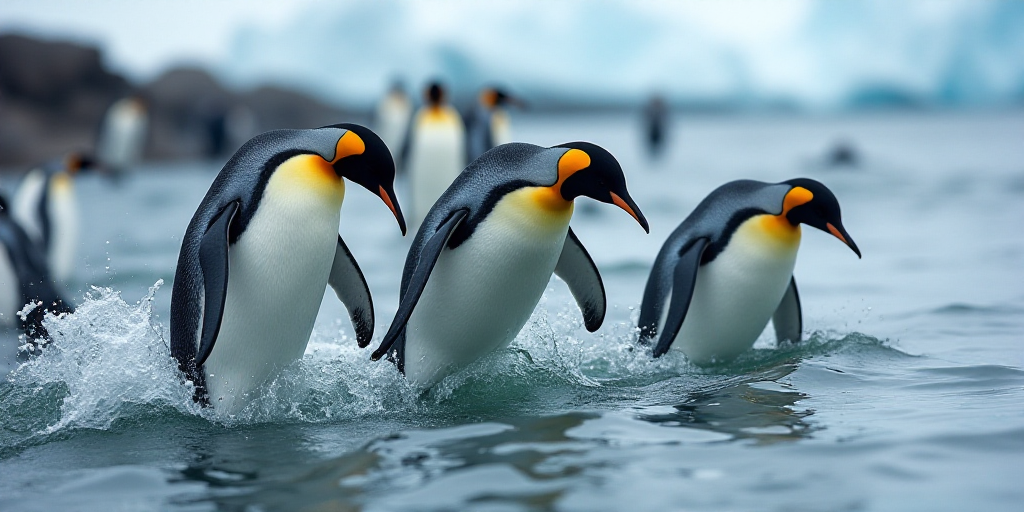
Study Reveals Climate Change’s Impact on Penguin Reproduction
Antarctic penguins are advancing their breeding season at an unprecedented rate due to climate change, according to a study published in the Journal of Animal Ecology.
International Research Analyzes a Decade of Observations
The study, led by Spanish researcher Ignacio Juárez Martínez from the Universities of Oxford and Oxford Brookes, analyzed a decade of observations and detected an extraordinary change in the reproductive patterns of penguins, closely related to rising temperatures on the continent.
Reduced Sea Ice Affects Hunting and Nesting Areas
Penguins’ reproduction is closely tied to food availability, and the reduction of sea ice has made hunting and nesting areas accessible for a more extended period throughout the year.
The researchers expected a slight advance in breeding, but they were “very surprised by both the magnitude and speed” of the advance, Juárez Martínez told AFP.
“The change is so significant that, in most areas, penguins now breed earlier than any historical records,” added the investigator.
Observations Between 2012 and 2022
For this study, scientists observed penguin breeding areas of emperor, Adélie, and gentoo species between 2012 and 2022 using dozens of cameras installed in colonies across Antarctica.
Emperor Penguins Show the Greatest Change
Emperor penguins showed the most significant change, advancing their breeding season by an average of 13 days over ten years and up to 24 days in some colonies.
This is the fastest change in breeding time observed so far in any bird and possibly any vertebrate, according to the researchers. Adélie and gentoo penguins also advanced their breeding, with an average of about ten days.
Winners and Losers Amid Climate Change
Antarctica is one of the world’s fastest-warming regions, with average annual temperatures reaching record highs last year, according to the Copernicus European observatory.
Scientists still don’t fully understand the exact mechanisms by which rising temperatures affect penguin behavior.
Traditionally, the three species staggered their breeding seasons, but the current advancement is causing overlaps, increasing competition for food and nesting spaces without snow.
This phenomenon benefits emperor penguins, better adapted natural collectors to warmer conditions, but harms Adélie and gentoo penguins, more dependent on krill and specific ice conditions.
“We have already observed emperor penguins occupying nests that previously belonged to Adélie or gentoo penguins,” Juárez Martínez noted.
“While emperor penguin populations are increasing in a warmer Antarctica, Adélie and gentoo penguin populations are declining due to their dependence on krill and specific ice conditions,” he added.
Implications for Global Species
Co-author Fiona Jones from the University of Oxford stated in a press release, “Given that penguins are considered a barometer of climate change, the study’s findings have implications for species worldwide.”
Juárez Martínez emphasized that it’s “still too early” to determine if this adaptation is beneficial or if penguins are forced into drastic changes affecting their reproductive success.
“Now we are studying each species’ ability to raise their chicks. If they maintain a high number of offspring, it will mean they are adapting to climate change,” he concluded.
Key Questions and Answers
- What is the main finding of the study? Antarctic penguins are advancing their breeding season at an unprecedented rate due to climate change.
- Which penguin species are most affected? Emperor, Adélie, and gentoo penguins are all experiencing changes in their breeding seasons.
- What are the implications of these changes? The study’s findings have global implications for species affected by climate change, as penguins serve as a barometer of these changes.
- How do rising temperatures impact penguin behavior? Scientists are still studying the exact mechanisms, but rising temperatures have led to changes in sea ice, affecting hunting and nesting areas.
- Who are the primary beneficiaries and losers of these changes? Emperor penguins, better adapted to warmer conditions, are primary beneficiaries, while Adélie and gentoo penguins, more dependent on krill and ice conditions, are losers.




