
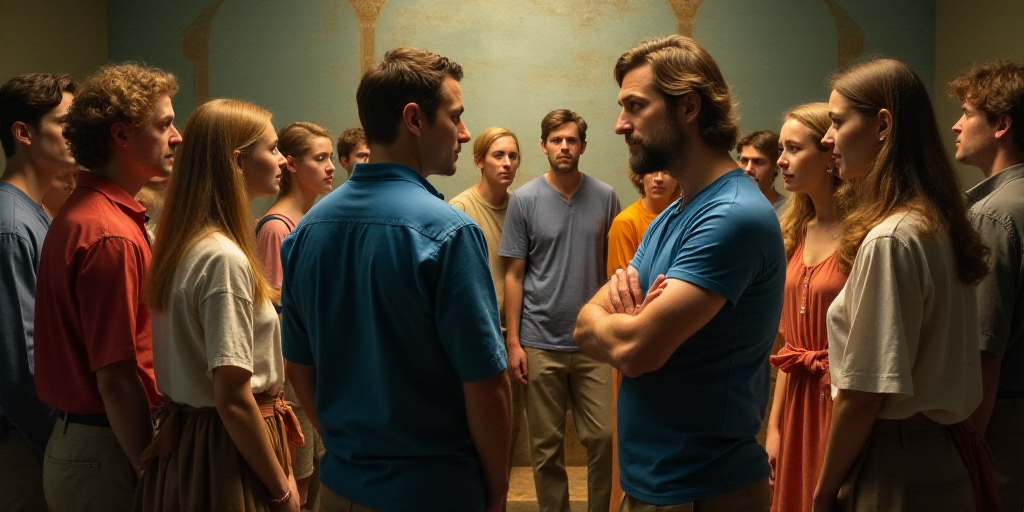
One of the most acclaimed television series in recent months, Pluribus, has the virtue of making us reflect through its narrative. Just as with the works of great artists, the fiction intuitively portrays profound anthropological questions: what value does the individual hold, how do we achieve our identity, and what constitutes happiness?
A Dystopian Beginning
The opening of the first episode immerses us in a dystopian scenario: an extraterrestrial virus has infected all of humanity. However, a select few individuals scattered across the globe remain immune. The virus, much like the soma in Huxley’s “Brave New World,” nullifies individuals and turns them into an amalgamation of indifferent beings, a collective mind where everyone feels and thinks alike, supposedly being happy.
Vince Gilligan’s Genius
The creator of the series, Vince Gilligan (also responsible for “Breaking Bad” and “Better Call Saul”), places the protagonist in a dilemma: join the happy ones or resist. Unlike Walter White’s initial decision to manufacture drugs in “Breaking Bad,” which bound him to a downward spiral, Carol Sturka’s character is meant to challenge, sometimes doubting, rebelling, and tempted to concede. Her constant decisions, made freely, will provoke attraction or repulsion.
Key Ideas on Individuality
Through this, we can outline some ideas to help us ponder what constitutes us as individuals and what destroys us.
“From Many, One”
The series title alludes to the Latin maxim on the U.S. seal, “E pluribus unum”: “from many, one.” It reflected the experience of the thirteen original colonies that united to form a single state.
However, any social group inherently implies plurality of its members. We are individuals, yes, but not isolated. We live in society, and the relationship between individual and group must be balanced without favoring one over the other. Julián Marías’ philosophy is particularly valuable in this regard.
Liberty and Creativity
Is it coincidental that the protagonist is a romantic novel writer? Sturka’s contribution may not be remembered in universal literature history. Yet, she had thousands of followers who found her books essential for understanding themselves and envisioning meaningful relationships.
Marías asserts that a person embodies in concrete reality, through an empirical structure where we establish ourselves in the world. His philosophy does not view personal identity as an abstract idea disconnected from reality but rather as establishment in the world. Identity is a narrative; each individual must write theirs, not follow an external pattern imposed.
Individuals in Society
Marías constructs, in “La estructura social,” one of the most lucid attempts to articulate anthropology with sociology. Society is the natural arena where each individual expresses and develops what they are in relation to others.
A key aspect of this social structure helps describe what happens in the series. Just as humans have organs enabling life, society has its own validity—beliefs, usages, and customs. We don’t choose them; we encounter them (language, laws, etc.). However, each individual configures themselves through dialogue or struggle with these.
Eternal Happiness?
We aspire to be happy, yes. But definitively, not as in the series: being happy does not equate to being bland. Carol Sturka is the perfect protagonist because she isn’t a flawless person. None of us are, even when we strive to shape our being optimally. She longs for the moments of happiness experienced before the alien virus absorbed everyone’s minds and nullified all hearts. She seeks new ones.
As Greek writer C. P. Cavafis expresses in his poem “Ithaka,” primordial happiness is rediscovered through a rich journey filled with experiences and knowledge. Hence, Marías speaks of personal identity as “radical innovation,” as it results from each individual’s journey, life understood as biography.
In Pluribus’ world, where everyone is the same, there’s no radical innovation, no individual identity—only photocopies.
Key Questions and Answers
- What is the central theme of Pluribus? The series explores profound anthropological questions about individual value, identity formation, and the nature of happiness.
- Who created Pluribus, and what are his previous works? Vince Gilligan, known for “Breaking Bad” and “Better Call Saul,” created Pluribus.
- What is the dystopian scenario presented in Pluribus? An extraterrestrial virus has infected humanity, turning most into mindless drones while a few remain immune.
- How does Marías’ philosophy relate to the series? Julián Marías’ ideas on individuality as a narrative and societal validity as a collective structure are central to understanding Pluribus.
- What does Marías mean by “radical innovation” regarding personal identity? He refers to personal identity as a unique narrative shaped by individual experiences and biographical journey.




