
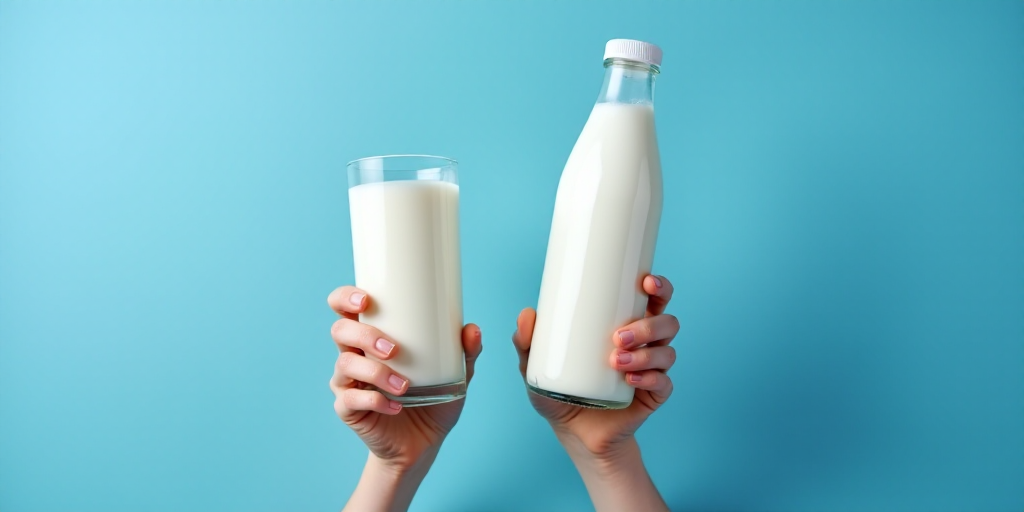
What Sets Milk Apart from Dairy Products?
On supermarket shelves, the word “milk” shares space with containers labeled as “dairy products” or “dairy beverages.” At first glance, they may seem interchangeable, but they are not. The distinction is based on technical criteria, nutritional value, and price that directly affect what consumers ingest and how much they pay.
Milk is an animal-derived food obtained directly from the mammary gland. After processes like pasteurization, it reaches consumers with minimal alterations to its basic composition. It provides complete protein, readily absorbable calcium, and lactose-based fat. When a product is sold as milk, it must adhere to this definition.
What is a Dairy Product and Why Does it Exist?
Dairy products originate from milk but include intentional modifications to their formula. They can have adjustments in fat type or amount, fortification with vitamins and minerals, or changes making them lighter or more functional for specific uses. They are not milk and thus cannot be sold as such, even though their origin remains lacteal.
From a nutritional perspective, these differences stem from technical decisions. As Maricarmen Mondragón, Nutrition Director at Grupo Lala, explains: “Milk is essentially direct: it’s obtained, pasteurized, and packaged. In a dairy product, there are deliberate modifications to the composition to meet specific nutritional, digestion, or lightness objectives.”
One significant adjustment is fat. Some dairy products remove the milk’s inherent fat—a saturated fat repurposed for other derivatives—and replace it with a smaller amount of high-quality vegetable oils. This reduces overall fat content and alters digestion patterns.
Nutrition, Price, and Informed Decision-Making
In Mexico, market dairy products typically have milk or milk derivatives as their base, combined with varying degrees of fortification. They often include added calcium, vitamins A and D, B-vitamins, and minerals like zinc or iron, according to the nutritional profiles aimed at addressing population needs.
Generally, milk maintains its natural composition while dairy products expand with specific nutritional profiles. The economic factor is also crucial: they are usually more affordable due to cost-optimizing formulations.
In a context of family budget pressures and increased nutritional awareness, distinguishing between milk and dairy products becomes a tool for informed consumption. It’s not about choosing good or bad, but understanding what each product offers and for which purposes it’s most suitable.
Even the way these products are named and communicated today is not coincidental. In Mexico, regulations on labeling and commercial naming have compelled companies to be clearer with consumers about what constitutes milk versus a dairy product. These rules prevent modified-formula products from being sold as “milk” to avoid confusion about their composition and nutritional contribution.
A clear example of this regulatory adjustment is the case of Nutri, previously known as “Nutri Milk,” which now reflects its nature more accurately as a dairy product following these provisions. The change wasn’t merely nominal but also communicative: making it clear that it’s a milk-derived alternative with a specific formulation and distinct nutritional goals.
Key Questions and Answers
- What is the difference between milk and dairy products? Milk is directly obtained from animal mammary glands with minimal processing, while dairy products are milk-based but include intentional modifications to their formula for specific nutritional, digestion, or lightness objectives.
- Why are there adjustments in dairy products? Adjustments often include fat modifications, fortification with vitamins and minerals, or changes to suit specific uses.
- How do these differences impact nutrition and price? Milk maintains its natural composition, while dairy products offer specific nutritional profiles. These formulations are often more affordable due to cost-optimizing processes.
- Why is it important for consumers to understand these differences? In a context of budget pressures and increased nutritional awareness, distinguishing between milk and dairy products empowers consumers to make informed decisions based on their needs.




