
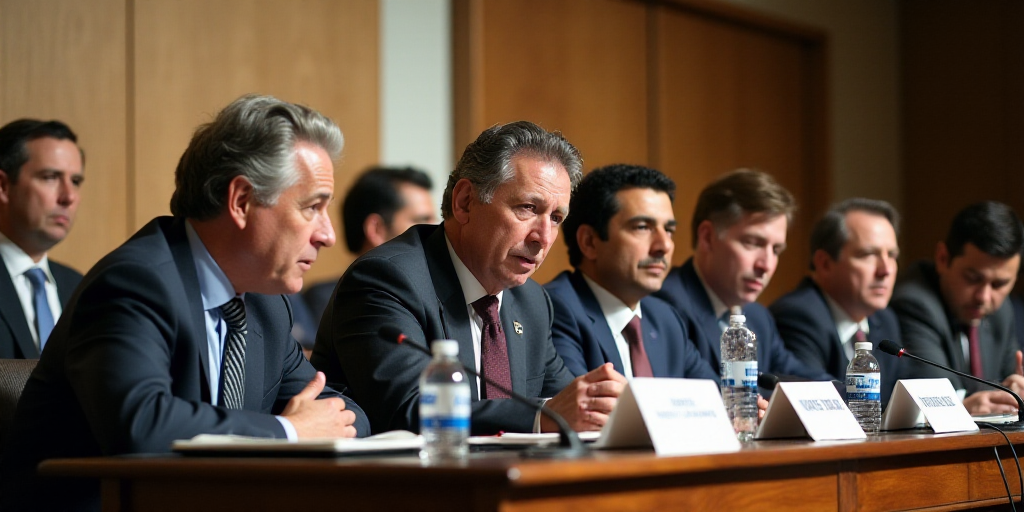
Introduction of Specialized Committees Across Mexico
The Mexico City government has established the first Investment Promotion Committee, a model that will be replicated in all 32 federal entities to expedite private investment processes at both local and federal levels.
Committee Composition
The Mexico City Committee comprises entrepreneurs, entrepreneurs, and consultants from various economic sectors, along with local government members. According to the Chief of Government, Shein Brugada, their task is to construct “Plan Mexico,” specifically focusing on supporting investments and identifying issues to ensure more investments.
Investment Trends in Mexico City
Foreign Direct Investment (FDI) in Mexico City increased by 45% from 2024 to 2025, while the local Gross Domestic Product (GDP) grew by 3.7% in Q2 2025, surpassing the national average.
Local Government Initiatives
The capital’s government created an investment attraction agency within the Secretariat of Economic Development (Sedeco), which currently tracks over 300 projects worth 197 billion pesos. To remove obstacles, they will simplify procedures and digitalize them.
Prioritized Sectors
The prioritized sectors for economic diversification include electromobility, digitalization, infrastructure, housing, pharmaceuticals, medical devices, circular economy, waste transformation, water technologies, financial services, logistics, and cultural industries & tourism.
Territorial Development Strategy
Brugada outlined a territorial development strategy based on “new centralities and specialized nodes,” with corporate and financial services concentrated along the Insurgentes-Viaducto corridor; cultural industries and entertainment in San Ángel; and logistics & transportation activities in the Aeropuerto-Central de Abasto corridor.
Moreover, Tláhuac and Iztapalapa can develop reindustrialization strategies with environmental responsibility, while continuing to expand the industrial development in Vallejo and Azcapotzalco. There’s also significant agroecological potential in the southern territories, and Tlalpan and Xochimilco offer favorable conditions for expanding biotechnology and pharmaceutical industries.
Investment Portfolio
Mexico’s federal government, under the leadership of Secretary of Economy Marcelo Ebrard, has registered a portfolio of investment projects exceeding 300 billion USD, with approximately 60% being foreign investments and the rest domestic capital.
Committee Implementation Across Mexico
Each entity will have its own committee, which will be officially established on February 4th in a meeting with President Claudia Sheinbaum. State Development Economy secretaries will participate, and each state’s specific investment projects will be presented.
Committee Responsibilities
The committees’ responsibility is to manage projects by coordinating with relevant departments, ensuring each project’s needs are met regarding dependencies like the Secretariat of Energy (SENER), Federal Electricity Commission (CFE), and the Secretariat of Environment and Natural Resources (SEMARNAT). Ebrard emphasized that the maturation of a project should not take more than a year, and their goal is to reduce this timeframe by one-third.
Key Questions and Answers
- What is the purpose of these committees? These committees aim to expedite private investment processes at local and federal levels by identifying issues and supporting investments.
- Which sectors are prioritized for economic diversification? The prioritized sectors include electromobility, digitalization, infrastructure, housing, pharmaceuticals, medical devices, circular economy, waste transformation, water technologies, financial services, logistics, and cultural industries & tourism.
- How will the committees manage projects? The committees will coordinate with relevant departments to ensure each project’s needs are met, aiming to reduce project maturation time by one-third.




