
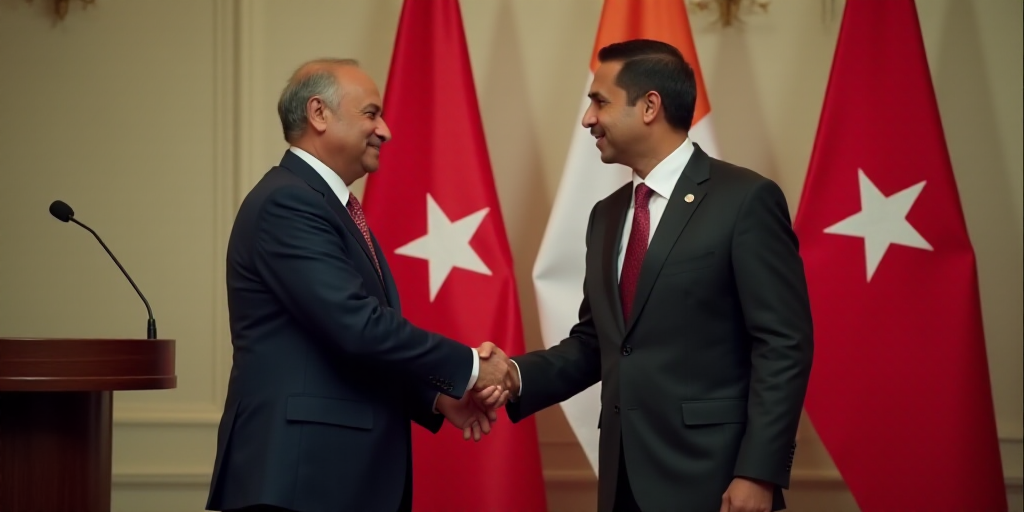
Background on Key Figures and Relevance
Donald Trump, the former President of the United States, recently announced a trade agreement with India. This move is significant as it reduces the mutual tariffs on Indian imports from 25% to 18%. The agreement aims to strengthen the trade relationship between the two nations and address some of India’s challenges in employment, poverty, and infrastructure.
Who is Donald Trump?
Donald Trump served as the 45th President of the United States from January 2017 to January 2021. Known for his business background and reality TV fame, Trump’s presidency was marked by several trade-related initiatives and renegotiations of existing agreements.
Who is Narendra Modi?
Narendra Modi is the current Prime Minister of India, serving since 2014. He has been instrumental in positioning India as one of the fastest-growing economies globally. Modi’s administration has focused on various reforms to boost manufacturing, attract foreign investments, and address persistent challenges like unemployment, poverty, and infrastructure development.
Key Points of the Trade Agreement
- Tariff Reduction: The most notable aspect of the agreement is the reduction of mutual tariffs on Indian imports from 25% to 18%. This move is expected to benefit both countries by promoting trade and investment.
- Elimination of Non-Tariff Barriers: Both nations have committed to reducing non-tariff barriers against each other, aiming for zero barriers by 2025.
- Increased Trade Target: The joint statement highlights the goal of elevating bilateral trade to $500 billion by 2030.
Impact on India’s Economic Goals
India, currently the world’s fifth-largest economy by nominal GDP and the most populous nation, aims to become a developed nation by 2047. The country’s G20 presidency in 2023 underscores its growing economic influence. However, India still faces challenges in employment generation, poverty reduction, and infrastructure development.
To tackle these issues, the Modi government has prioritized strengthening the manufacturing sector and attracting foreign investments in areas like infrastructure, energy, information technology, and semiconductors.
India’s Trade Relations with Other Countries
Amidst the trade agreement with the United States, India has also been exploring alternative trade partnerships. For instance, in mid-December, India proposed a preferential trade agreement with Mexico as a countermeasure to unilateral tariff hikes by the Mexican Congress.
- Trade Deficit with Mexico: In 2024, Mexico recorded a trade deficit of $7,975 million with India, with exports valued at $1,001 million and imports totaling $8,976 million, according to the World Trade Organization (WTO) data.
- Indian Auto Exports to Mexico: In 2024, India exported automobiles worth $1,330 million to Mexico, making it the third-largest destination for Indian auto exports after Saudi Arabia and South Africa.
Key Questions and Answers
- What is the main objective of this trade agreement? The primary goal is to strengthen the trade relationship between the United States and India by reducing tariffs and non-tariff barriers, ultimately aiming to increase bilateral trade to $500 billion by 2030.
- How does this agreement impact India’s economic goals? The agreement supports India’s efforts to address challenges in employment, poverty, and infrastructure while positioning the country as a significant global economic player by 2047.
- What are India’s alternative trade initiatives? Amidst the US trade agreement, India has also proposed a preferential trade agreement with Mexico to counterbalance unilateral tariff hikes by the Mexican Congress.




