
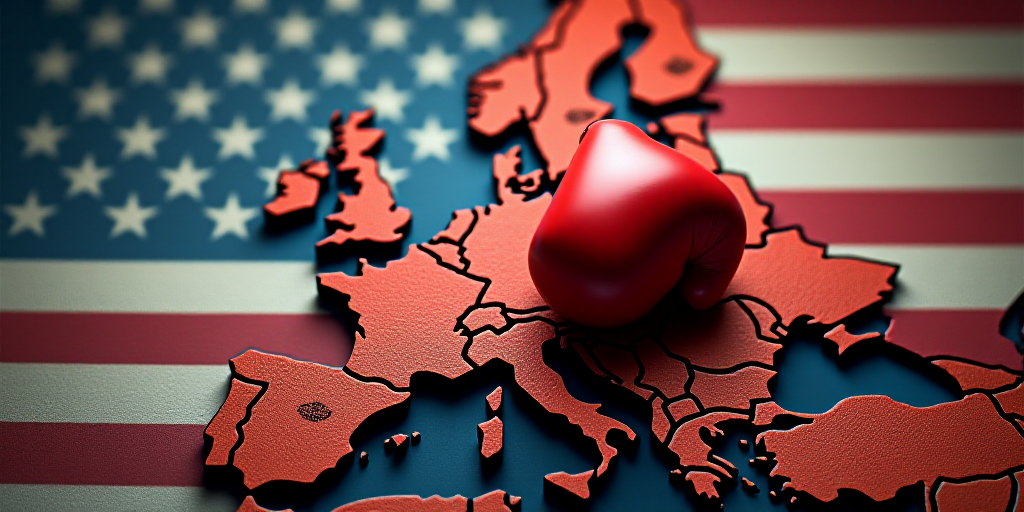
Trump’s Trade Policies: A Shift from Free Trade
In 2025, the world witnessed significant changes in global economic order due to U.S. President Donald Trump’s imposition of universal tariffs, marking an end to decades of free trade. Trump’s focus on tariffs against China and Mexico, a key trading partner alongside Canada in the U.S.-Mexico-Canada Agreement (T-MEC), signified a shift towards protectionism.
Historically, the implementation of tariffs and protectionist policies has led to increased consumer prices, job losses, and reduced global economic growth due to decreased international trade. Trump’s actions have sparked debates about the balance between safeguarding domestic industries and maintaining global economic stability.
Iberian Blackout: A Lesson in Energy System Balance
On April 28, a widespread power outage occurred in Spain, raising concerns about the country’s energy system design and prompting reflection on maintaining equilibrium across all stages of the electrical grid.
The event highlighted the complexities and delicacies of balancing the energy system, emphasizing the need for secure electricity supply amidst growing demand driven by digitalization and technological advancements. The incident also reignited discussions about the role of nuclear energy, acknowledging both its stability and associated long-term contamination risks.
Technological Society: AI, Chips, and Bubbles
In early 2025, China surpassed the U.S. in a significant technological battle by developing a powerful AI with limited resources, thanks to the lack of access to Nvidia’s chips. This achievement underscored the global AI race and the importance of semiconductor technology.
Despite the technological enthusiasm, it’s essential to remember that major disruptions typically follow two phases: installation and deployment. The initial rapid and frenzied phase often creates a bubble (e.g., the dot-com bubble in the early 2000s), which eventually bursts. Analysts had already begun questioning whether the chip market could become a new technological bubble earlier in the year.
Nonetheless, the market maintained its upward trajectory throughout 2025, with Nvidia’s stock value multiplying by thirteen since early 2023. This growth can be attributed to factors such as the burgeoning new technologies and low-interest rates, which encourage investors to seek more profitable alternatives than traditional markets.
However, after periods of excessive market growth, price corrections often follow when a sufficient number of investors recognize that many assets are overvalued.
Fads, Labubus, and Luxury: The Intangible Value
Similar to the chip market, the fashion, luxury, and trend sectors experienced a surge with labubus dolls, transitioning from niche products for enthusiasts to coveted items among fashionistas. Wang Ning, the founder of Pop Mart, witnessed his wealth grow by $20 billion due to this unexpected success.
In the luxury sector, concerns emerged at the start of 2025 regarding waning Asian economies, crucial drivers of the industry. Additionally, TikTok’s influence raised questions about the relationship between quality and price perception in the luxury market.
The importance of intangible value, which is unseen but felt, plays a significant role in both luxury and eccentric doll markets. Factors such as brand history, origin, values, and aesthetics contribute to making a product desirable, even if its tangible attributes aren’t exceptional.
Nobel 2025: Economic Development and Creativity
On October 13, the Sveriges Riksbank announced the Nobel Prize in Economic Sciences to Joel Mokyr, Philippe Aghion, and Peter Howitt for explaining economic growth driven by innovation.
Mokyr, an economic historian, has extensively studied the circumstances that enabled the Industrial Revolution, arguing that genuine development drivers were curiosity, ideas, and belief in progress rather than machinery.
Aghion and Howitt have described in their work how innovation paves the way for progress. Both are followers of Joseph Schumpeter’s concept of “creative destruction,” emphasizing the importance of nurturing innovation and its associated risks for dynamic economies.
This Nobel Prize reinforces the notion that fostering and supporting entrepreneurship is crucial.
The Essentials of Entrepreneurship: Creativity, Experience, and Risk Tolerance
Entrepreneurship requires a balanced mix of creativity for generating innovative ideas, substantial experience for making informed decisions, and risk tolerance to face the challenges of starting a business.
Social stereotypes and gender also influence entrepreneurship, as it’s often associated with typically masculine traits like competitiveness, aggression, and risk-taking. This perception affects initial predisposition to entrepreneurship, though women are significantly less likely than men to act on these initial interests.
Entrepreneurial ideas usually require external funding. Knowing how to pitch ideas to potential investors is crucial, as emotions displayed by entrepreneurs while presenting their projects impact investor decisions.
In crowdfunding, two factors come into play: the entrepreneur’s narrative about their project and how they present it, as well as observing signals from experienced investors and mimicking their investment behavior.
May the upcoming year bring more reassuring news regarding tariffs and trade wars, allowing creativity and innovation to thrive as drivers of economic development.
Wishing you a prosperous 2026!




