
Background on Key Figures and Institutions
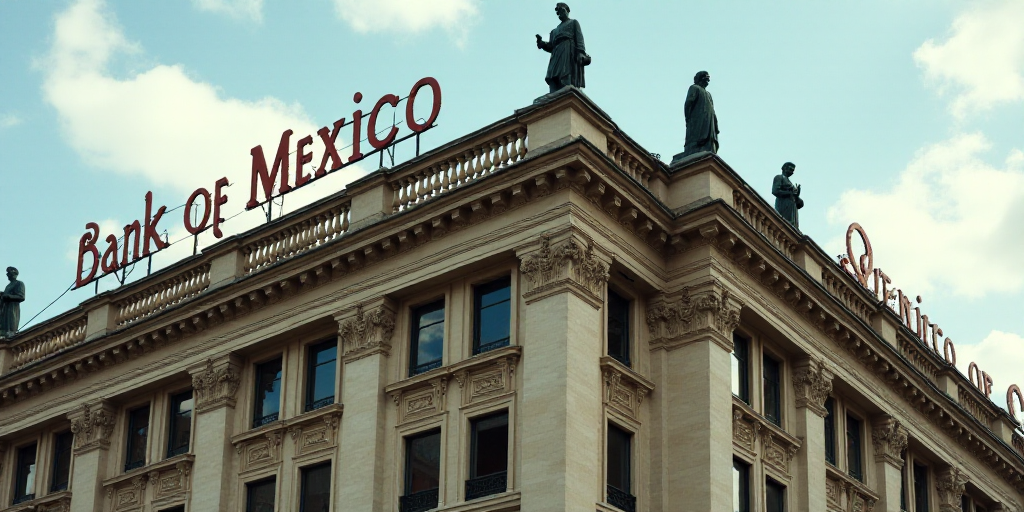
The Banco de México (Bank of Mexico) and the Federal Reserve (Fed) play crucial roles in shaping their respective countries’ monetary policies. The Bank of Mexico, led by Governor Victoria Rodríguez Ceja, is responsible for managing Mexico’s monetary policy. Meanwhile, the Federal Reserve, under its Federal Open Market Committee (FOMC), influences US monetary policy.
Alejandro Valerio, CEO and founder of Valerio Consulting Group based in Washington, provides insights into the relationship between these institutions. His expertise helps interpret the implications of their policy decisions.
Staggered Announcements: Minimizing Market Volatility
In 2026, the Banco de México will announce its monetary policy decisions seven to eight days after the FOMC’s scheduled announcements. This staggered approach aims to minimize the impact of potential market volatility caused by interest rate movements from the Fed.
Valerio explains that if the Fed continues to lower interest rates as anticipated, Banco de México will follow suit, maintaining the same magnitude of change.
The Interest Rate Differential and Exchange Rate
The interest rate differential refers to the gap between Mexico’s premium (7%) and the Fed’s rate range (3.50% to 3.75%). Currently, this differential ranges from 325 to 350 basis points and is known as the “relative stance.”
Subgobernador Jonathan Heath notes that the relative stance has lost relevance for Banxico’s decisions since March 2022, when the Fed started raising rates and achieved a differential of 600 basis points.
This differential remains above the historical average that supported the Mexican peso before the pandemic, which was between 450 and 475 basis points, according to experts from Valmex.
Humberto Calzada, Chief Economist for Latin America at Rankia, recalls that Banxico anticipated the Fed’s rate-cut cycle starting in March 2024, while the FOMC only began in September of that year.
“The correlation with the Fed was lost last year, and consequently, Banxico also distanced itself from other central banks,” Calzada emphasizes.
He adds that Banxico’s stance has been guided by inflation trends, with the Governing Board adjusting monetary policy based on internal conditions.
Calzada dismisses the peso’s strength against the dollar or the interest rate differential as determinants for rate flexibility.
However, an expert from Banco Base suggests that continuing the rate-cut cycle will make the exchange rate less attractive, turning it into a market risk factor.
Upcoming Monetary Policy Decisions in 2026
The first monetary policy decision of 2026 will be announced by Banco de México on January 8.
Key Questions and Answers
- What is the relationship between Banco de México and the Federal Reserve? Both institutions play vital roles in their respective countries’ monetary policies. Banco de México is led by Governor Victoria Rodríguez Ceja, while the Federal Reserve operates under its FOMC.
- Why does Banco de México stagger its announcements with the Fed? This approach aims to minimize market volatility caused by interest rate movements from the Fed.
- What is the current interest rate differential between Mexico and the US? The differential ranges from 325 to 350 basis points, with Mexico offering a premium of 7% and the Fed’s rate between 3.50% and 3.75%.
- How has the relative stance lost relevance for Banxico’s decisions? Since March 2022, when the Fed began raising rates and achieved a differential of 600 basis points, the relative stance has become less significant for Banxico.
- What factors influence Banco de México’s monetary policy decisions? Banxico’s stance is primarily guided by inflation trends, with the Governing Board adjusting monetary policy based on internal conditions.
- What are the implications of continuing the rate-cut cycle? Continuing the rate-cut cycle may make the exchange rate less attractive and introduce it as a market risk factor.




