
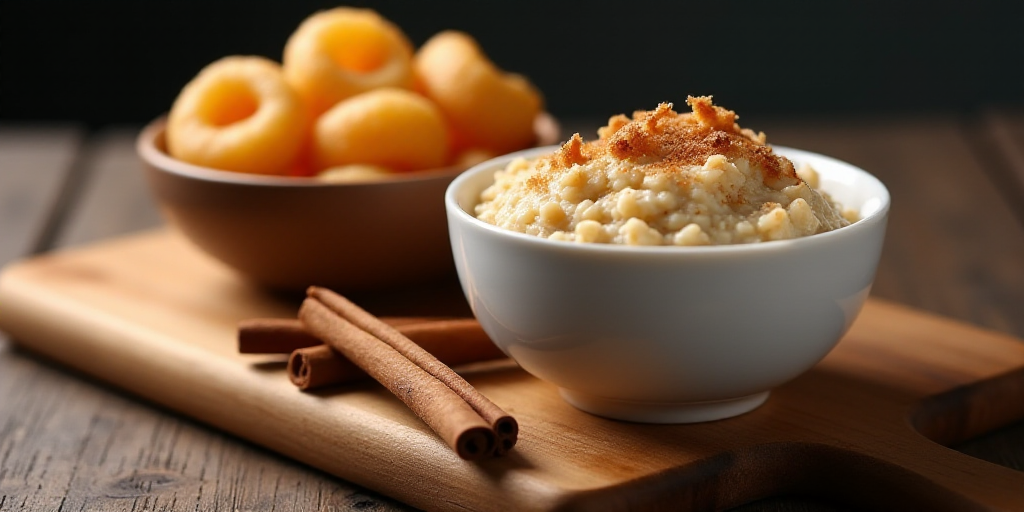
Arroz con Leche: From Asian Grain to Universal Dessert
Rice, one of Asia’s significant contributions to the world, was domesticated thousands of years ago in southern China and Southeast Asia. It served as a staple food, cultural currency, and symbol of abundance. Crucially, long before reaching Europe, rice was being cooked with sweet liquids and animal or dairy fats.

Arroz con leche.
In Central Asia and the Indian subcontinent, there were preparations where rice was slowly cooked with milk, honey, palm sugar, and aromatic spices. These were not “desserts” as we understand them today but energy-rich dishes, rituals, and acts of hospitality. The technique—prolonged cooking to achieve creaminess—is the heart of modern arroz con leche.
With the expansion of medieval Islamic world, these recipes traveled to Persia, the Levant, and North Africa. Rice combined with goat or sheep milk, rose water, and nuts. When rice arrived in the Iberian Peninsula, it brought with it an implicit recipe: how to make it creamy, how to sweeten it, and how to flavor it.
Europe contributed local variations—canela, refined sugar, cow’s milk—and turned it into a convent dessert and home-style dish. However, the technical logic and the rice-milk pairing were already established in Asia centuries before. America adopted and tropicalized it: evaporated milk, piloncillo, citrus zest. The result appears “traditional” in each place, though its DNA is Asian.
Churros: From Chinese Frying to Iberian Breakfast
The story of churros is even more intriguing. The key reference is the youtiao, a long fried dough stick consumed in China for over a millennium, traditionally at breakfast. Its preparation—simple dough, deep-frying, elongated shape—coincides with the churro’s technical principle.

Churros
When this technique reached the Iberian Peninsula—likely through commercial and cultural contacts with the Islamic world—it adapted to local wheat, sweetened, and standardized. Thus, the churro as we know it was born: wheat flour, water, and salt (sometimes sugar), deep-fried until crispy and hollow. The hot chocolate, however, is a European addition later.
The romantic notion of the churro as a Spanish shepherd’s invention weakens faced with this technical genealogy. Spain did not “create” the churro; it refined, urbanized, and turned it into a symbol. America Latina did the same, adding fillings, sugars, and new consumption occasions.
Key Questions and Answers
- What is the Asian influence on arroz con leche and churros? The origins of both dishes lie in Asia, with rice cultivation and frying techniques traveling along the Silk Road. Europe adapted these recipes, adding local ingredients and context.
- How did the arroz con leche evolve? Originating from slow-cooked rice with sweet liquids and animal or dairy fats in Asia, it spread to the Middle East and North Africa before reaching Europe. European variations like canela, refined sugar, and cow’s milk transformed it into a dessert.
- What is the history of churros? The youtiao, a long fried dough stick from China, shares the same frying technique as churros. This method traveled along trade routes, adapting to local ingredients and becoming the churro when it reached the Iberian Peninsula.
- Why are these dishes significant? Arroz con leche and churros demonstrate that gastronomic identity is not defined by origin but by cultural appropriation. They are traveling dishes, shaped by trade routes, empires, migrations, and domestic economies.




