
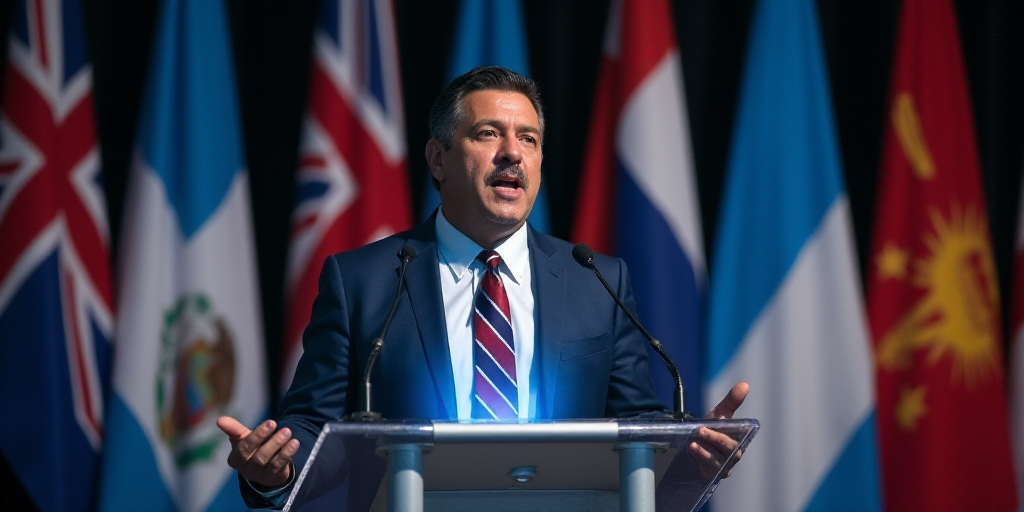
Background on Gustavo Petro and His Relevance
Gustavo Petro, the current President of Colombia, has been a prominent figure in Colombian politics for many years. A former guerrilla member and senator, Petro represents the left-wing Movement of Socialism Party. His political career has been marked by advocating for social justice, human rights, and environmental protection. As president since August 2022, Petro’s administration has been focused on addressing inequality and corruption while navigating international relations.
Trade Agreement Tensions with the United States
In recent developments, President Petro addressed ongoing tensions with the United States, specifically regarding the Trade Agreement (TLC) between Colombia and the U.S.
“The TLC is de facto suspended due to the 10% general tariff imposed by the U.S. and the elimination of trade preferences,” Petro stated. He further explained that Colombia has maintained the surviving clauses of the TLC “because we wanted to,” but the Ministry of Commerce holds decrees with a Colombian stance defending national labor and human life.
Petro’s Response to U.S. Tariffs
Petro emphasized that Colombia’s response to these tariffs would be “intelligent.” He highlighted the importance of safeguarding Colombian interests, particularly in labor and human rights. The president also mentioned that he would convene a meeting on Monday with key ministers, including the Minister of Foreign Affairs, Commerce, Industry and Tourism, Agriculture, Defense, Ambassador Daniel García-Peña, and the head of the illicit crop substitution program.
Petro’s Stance on U.S. Influence and Drug War
Petro asserted that true control over democracy lies with the people, not foreigners who dislike migrants and Latin Americans. He stated that Trump does not control Colombia; he only responds to the Colombian and Latin American people.
Regarding the ongoing drug war, Petro blamed the United States for Colombia’s conflict. He pointed out that urban and rural violence in Colombia over the past five decades stems from cocaine consumption in the U.S., despite some contributions to Colombia’s peace from American governments, which have been insufficient in recent years.
U.S. Responsibility for Colombian Casualties
Petro accused the U.S. of being responsible for 300,000 deaths in Colombia and 700,000 more across Latin America. He urged the international community to recognize this responsibility and work towards resolving these long-standing issues.
Government Progress in Drug War
Petro reported that the government managed to seize 2,800 tons of illicit substances in the past year. He credited cooperation with European and North American intelligence agencies for this success, stating that the removal of tariff advantages was a crucial step in leveling the playing field against drug traffickers.
Key Questions and Answers
- What is the current state of the TLC between Colombia and the U.S.? According to President Petro, the TLC is suspended in reality due to tariffs imposed by the U.S. and the elimination of trade preferences.
- How has President Petro responded to U.S. tariffs? Petro stated that Colombia’s response will be “intelligent,” emphasizing the protection of national interests in labor and human rights.
- What is Petro’s stance on U.S. influence in Colombia? Petro asserts that true control over democracy lies with the Colombian people, not foreigners.
- How does Petro view the U.S.’s role in Colombia’s drug war? Petro blames the U.S. for fueling Colombia’s conflict through cocaine consumption, despite some contributions to peace efforts.
- What responsibility does Petro attribute to the U.S. in Colombia? Petro holds the U.S. responsible for 300,000 deaths in Colombia and 700,000 more across Latin America.
- What progress has the Colombian government made in combating drug trafficking? In the past year, the government seized 2,800 tons of illicit substances with assistance from European and North American intelligence agencies.




