
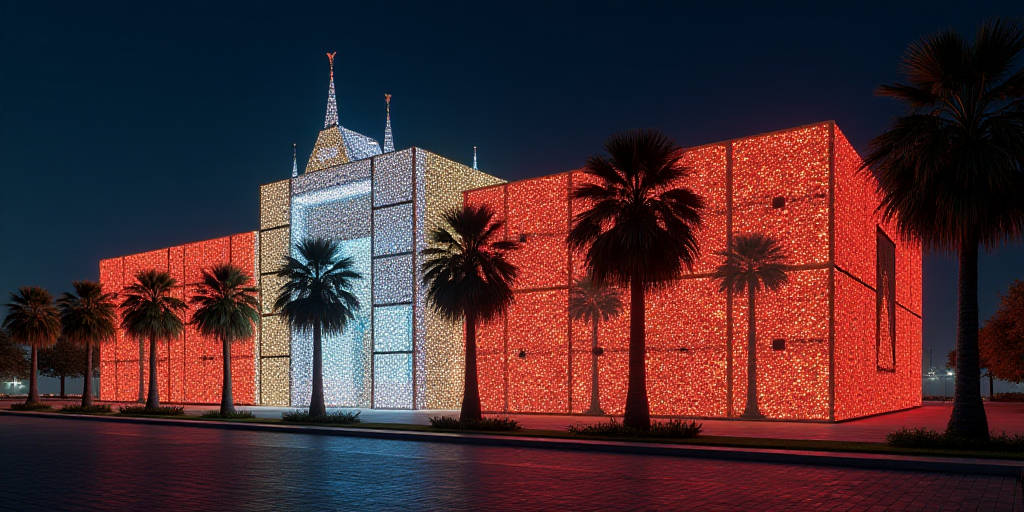
A Pharaoh-Themed Show Kicks Off the Grand Egyptian Museum
A faraonic spectacle with laser lights, a symphony orchestra, dancers in ancient-inspired tunics, golden scepters, and crowns marked the official opening of the Grand Egyptian Museum (GEM) in Cairo on Saturday night.
Egypt’s President, Abdel Fatah al Sisi, declared, “We are writing a new chapter in the history of the present and future for this ancient land,” praising “the largest museum in the world dedicated to a single civilization” before an audience of kings, heads of state, and international leaders.
“It is a living testimony to the ingenuity of the people of Egypt,” he added on the museum’s grand stone and crystal expanse, overlooking the Guiza pyramids bathed in golden lights.
Drones, Ballet, and Fireworks: A Spectacular Inauguration
As guests arrived, drones drew a message over the three pyramids and the Sphinx, welcoming visitors to “the land of peace” in English. Following this, spectacular ballet and opera scenes were performed by dozens of artists and performers in ancient attire, culminating in massive fireworks lighting up the sky.
“We all imagined and dreamed of this project. We wondered if it would ever become a reality, if we’d see its implementation and witness this great day,” said Prime Minister Mostafa Madbouly during a press conference.
Egypt as the Center of Egiptología
The construction of the building, supported financially and technically by Japan, cost over a billion dollars and took twenty years of arduous work. The idea for the museum dates back about thirty years, with most of the process developed over the last seven to eight years following a period of interruption due to Egypt’s circumstances starting in 2011.
The main attraction is Tutankhamun’s treasure, discovered in 1922 in an undisturbed tomb in the Valley of the Kings, Upper Egypt, featuring approximately 5,000 funerary objects gathered for the first time in one space.
The GEM houses over 100,000 archaeological pieces, with half on display. This collection is the largest in the world dedicated to a single civilization, spanning 5,000 years of history through thirty dynasties.
Public Opening and Future Hopes for Tourism
On its public opening day, visitors will be greeted in the vast atrium by the museum’s most monumental statue—83 tons of granite, eleven meters high—representing Ramses II, the pharaoh who ruled Egypt for 66 years over 3,000 years ago.
Unlike the colonial-era Egyptian Museum in central Cairo, now outdated and deteriorating, the GEM offers immersive galleries, precise lighting, virtual reality exhibits, and even a children’s museum.
Archaeology enthusiasts can observe the conservation lab’s work through a window, where a 4,500-year-old solar boat is being restored, found buried near Keops’ pyramid.
“Egypt will become the center of egiptología… It’s unacceptable that most international conferences are held outside the country,” stated Tourism Minister Sherif Fathi during a press meeting.
Tourism Recovery and Future Plans
Egypt’s tourism sector, a vital source of foreign exchange and employment, has been shaken in recent years since the 2011 revolution until sporadic riots and terrorist attacks followed.
In recent years, tourism has shown signs of recovery, with 15 million visitors in Egypt during the first nine months of 2025, generating $12.5 billion—a 21% increase from the previous year.
Currently seeing between 5,000 and 6,000 daily visitors, the minister expects to reach 15,000, estimating an annual growth of five million tourists, “most of whom will visit the museum,” he said.
The government is currently working on a comprehensive development plan for northeast Cairo, extending from the new Esfinge International Airport to the Saqqara pyramids, including hotels, restaurants, and shopping centers, according to Fathi, avoiding any questions about the ceremony’s cost.
Key Questions and Answers
- What is the Grand Egyptian Museum (GEM)? The GEM is a state-of-the-art museum in Cairo, Egypt, housing over 100,000 archaeological pieces, including Tutankhamun’s treasure and artifacts from 5,000 years of Egyptian history.
- Why is the GEM significant? The GEM is significant as it’s the largest museum dedicated to a single civilization, offering immersive galleries, virtual reality exhibits, and a children’s museum.
- What is the current state of Egypt’s tourism sector? Despite past challenges, including the 2011 revolution and sporadic terrorist attacks, Egypt’s tourism sector has shown signs of recovery with 15 million visitors in the first nine months of 2025.
- What are the future plans for Cairo’s northeast development? The government is working on a comprehensive plan extending from the new Esfinge International Airport to the Saqqara pyramids, including hotels, restaurants, and shopping centers.




