
Background on Super Typhoon Fung-wong
Super Typhoon Fung-wong made landfall on the eastern coast of the Philippines Sunday, according to the national weather service, after causing at least two deaths and forcing over a million people to evacuate their homes. The typhoon, with a radius covering almost the entire Philippine territory, hit land in Aurora province on Luzón island at 21:10 (13:10 GMT) Sunday, just days after another typhoon devastated the country.
Impact and Casualties
Authorities warned that the typhoon would bring strong winds and heavy rains across wide areas of the archipelago, where more than 220 people died last week due to Typhoon Kalmaegi. On Sunday, one central Philippine province already hit by the storm reported its first known death caused by Fung-wong.
- Casualty 1: A 64-year-old woman attempting to evacuate was found dead among debris and fallen trees in Catbalogan, according to rescuer Juniel Tagarino.
- Casualty 2: A person drowned in a sudden flash flood on Catanduanes island, confirmed by the civil defense office.
In Aurora, where the eye of the storm made landfall, 34-year-old Aries Ora reported light rain while reinforcing his home in Dipacúlao with steel sheets and wooden planks. “What really worries us is that the typhoon is expected to hit at night,” Ora said. “Unlike previous typhoons, we won’t be able to clearly see the wind direction and what’s happening around us.”
Further north, in Cagayán province, people sheltering in an evacuation center cited fear of flooding as the reason for leaving their homes.
School and Government Office Closures
Schools and government offices will be closed Monday on Luzón island, including the capital Manila, where around 300 flights have been canceled so far.
Mass Evacuations
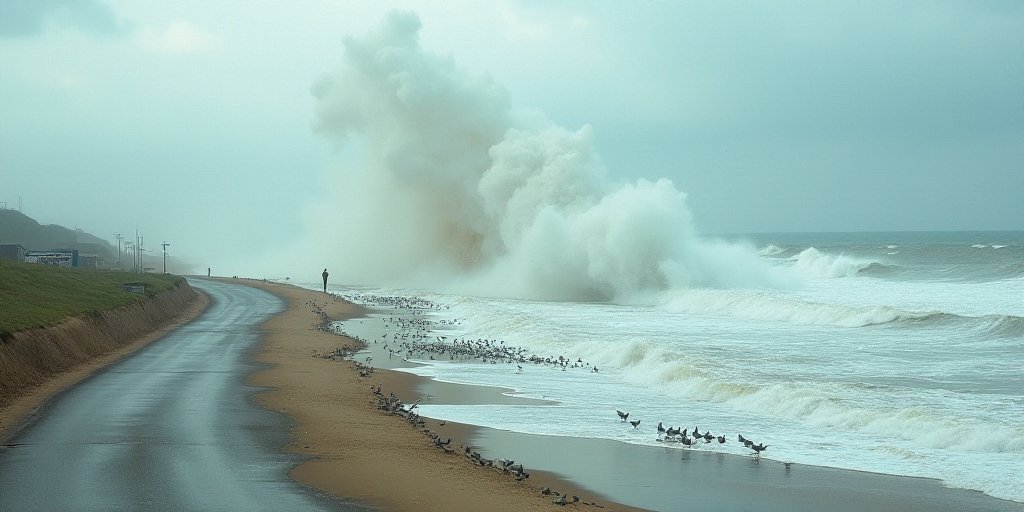
More than a million people have been evacuated, with Catanduanes, a small island potentially in Fung-wong’s direct path, experiencing strong winds and heavy rainfall Sunday morning. Flooding occurred in some areas, with waves starting to crash around 7:00 am in Virac, Catanduanes, as reported by Edson Casarino.
“The waves started roaring around 7:00 am. When the waves hit the seawall, it felt like the ground was shaking,” said 33-year-old Virac resident Edson Casarino to AFP.
A verified video showed a church in Guinobatan, a town of about 80,000 in Albay province, submerged due to sudden flooding. Authorities ordered the preventive evacuation of nearly 1.2 million people across the archipelago, according to Rafaelito Alejandro, deputy director of civil defense.
Climate Change and Increasing Typhoon Intensity
Scientists warn that typhoons are becoming more powerful due to human-induced climate change. Warmer oceans accelerate typhoon strengthening, while a warmer atmosphere retains more moisture, leading to heavier rainfall.
The previous week, Typhoon Kalmaegi caused significant flooding in Cebu and Negros islands, leaving at least 224 dead and 109 missing, according to the latest government figures updated Sunday.
Key Questions and Answers
- Q: Who is Super Typhoon Fung-wong affecting? A: The Philippines, with Luzón island and its capital Manila being significantly impacted.
- Q: How many people have been evacuated? A: More than a million people have been evacuated due to the typhoon.
- Q: How many deaths have been reported so far? A: At least two deaths have been confirmed, with more expected as the storm’s impact is fully assessed.
- Q: Why are typhoons becoming more intense? A: Warmer ocean temperatures and a warmer atmosphere, both results of climate change, contribute to more powerful typhoons and heavier rainfall.




