
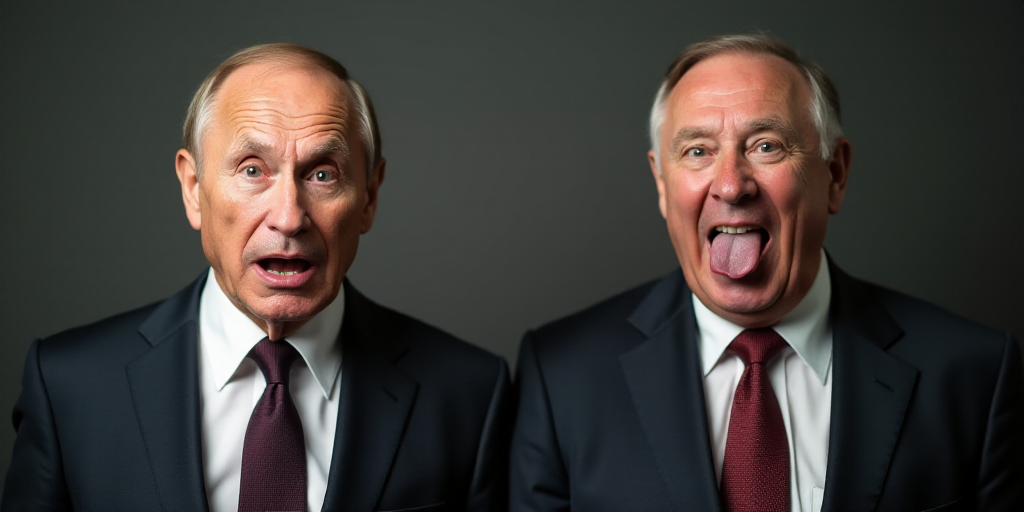
Background on Key Figures and Relevance
The planned summit between U.S. President Donald Trump and Russian President Vladimir Putin is now uncertain, as Moscow’s refusal to agree to an immediate ceasefire in Ukraine casts a shadow over negotiation efforts. Both leaders have been key figures in international diplomacy, with their relationship significantly impacting global politics.
Donald Trump, the 45th President of the United States, has sought to improve relations with Russia since taking office. Meanwhile, Vladimir Putin, the President of Russia since 2012 (after previously serving as Prime Minister under Dmitry Medvedev from 2008 to 2012), has maintained a firm stance on various international issues, including the conflict in Ukraine.
Summit Plans and Recent Developments
Trump had announced last week that he and Putin would soon meet in Hungary to try to end the war in Ukraine. However, Putin has shown little willingness to consider concessions. Moscow has long demanded that Ukraine cede more territory before any ceasefire, according to a high-ranking U.S. official.
A White House official stated on Tuesday that “there are no plans for President Trump to meet with President Putin in the near future,” following a fruitful conversation between U.S. Secretary of State Marco Rubio and Russian Foreign Minister Sergei Lavrov, who opted not to meet in person.
When questioned about the possibility of a summit, Trump mentioned that he did not want an “unproductive meeting,” but hinted at potential updates, saying, “we will inform you in the next two days.”
Kirill Dmitriev, Putin’s envoy for investments, posted on social media that preparations for the summit “continue.”
Russia’s Conditions for Peace
Russia reiterated its long-standing conditions for a peace agreement in a private “non-paper” sent to the U.S. over the weekend, according to two U.S. officials and two individuals familiar with the situation.
The document reinforced Russia’s demand for full control over the eastern Donbas region, which has been disputed for a long time. It also rejected Trump’s call for a ceasefire starting with the freezing of front lines at their current positions, as per a U.S. official.
Russia controls the entire Luhansk province and around 75% of neighboring Donetsk, forming the Donbas region. European leaders urged Washington to remain firm on its demand for an immediate ceasefire in Ukraine and use the existing battle lines as a basis for any future talks.
NATO’s Role and European Perspectives
NATO Secretary-General Mark Rutte traveled to Washington on Tuesday for discussions with Trump, which are expected to take place on Wednesday, according to two sources familiar with the matter.
A Western official, speaking on condition of anonymity, said Rutte planned to present Trump with European views on a ceasefire and any subsequent peace negotiations.
Key Questions and Answers
- Q: What is the current status of the Trump-Putin summit? The summit’s future is uncertain due to Moscow’s rejection of an immediate ceasefire in Ukraine.
- Q: Why is the summit in jeopardy? Moscow’s insistence on Ukraine ceding more territory before a ceasefire, along with their refusal to commit to an immediate truce, has put the summit in doubt.
- Q: What are Russia’s conditions for a peace agreement? Russia demands full control over the Donbas region and rejects freezing front lines at their current positions as proposed by Trump.
- Q: How are European leaders responding to the situation? European leaders urge Washington to maintain its demand for an immediate ceasefire in Ukraine and use existing battle lines as a basis for future talks.
- Q: What role is NATO playing in this situation? NATO Secretary-General Mark Rutte is engaging with Trump to discuss European perspectives on a ceasefire and subsequent peace negotiations.




