
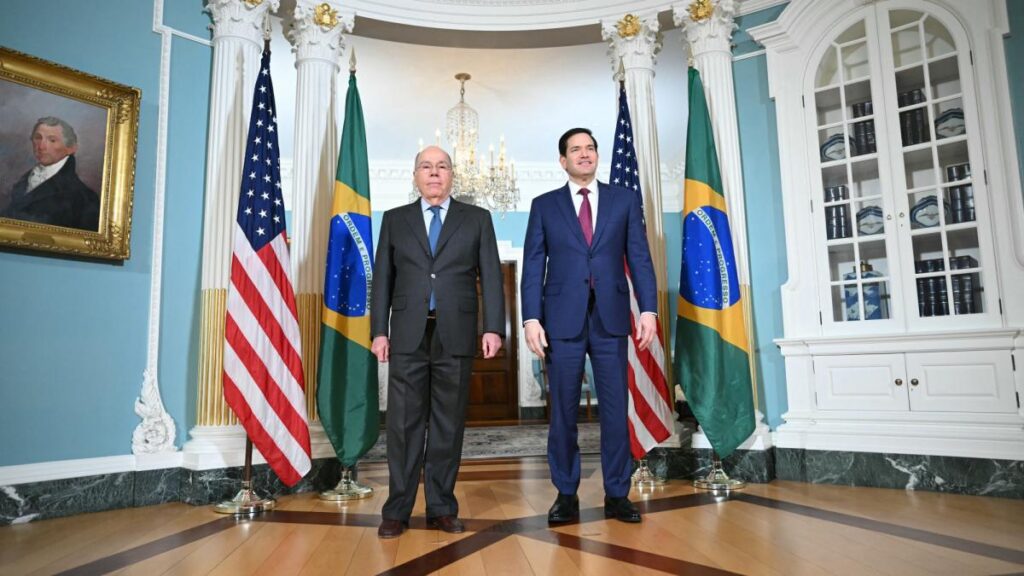
Background on Key Figures and Context
The United States and Brazil are making progress towards a provisional agreement that could unlock their bilateral relations by the end of this month, according to Brazil’s Foreign Minister Mauro Vieira. This development comes after a series of meetings between Vieira and his U.S. counterpart, Marco Rubio, in Washington and Canada during a G7 meeting.
Mauro Vieira, Brazil’s Foreign Minister, and Marco Rubio, the U.S. Senator, have been at the forefront of these negotiations, aiming to resolve trade disputes initiated by former U.S. President Donald Trump. Trump imposed steep tariffs, including a 50% duty on numerous Brazilian products, as retaliation against Brazil’s legal proceedings against its former ally, ex-President Jair Bolsonaro, who was sentenced to 27 years in prison.
These tariffs affected various Brazilian exports, such as coffee, which saw a 21% interannual price increase in the U.S. market during August.
Key Developments and Proposals
During their meetings, Rubio reaffirmed the U.S. proposal for a provisional agreement by the end of this month or early next, establishing a roadmap for negotiations that could last two to three months. This would eventually lead to the finalization of all issues between the two countries, according to Vieira.
The U.S. Department of State released a brief statement confirming that both parties discussed a mutual framework for their bilateral commercial relationship.
Both countries have exchanged trade proposals, and now the U.S. is expected to respond to Brazil’s latest offer, as stated by Vieira.
Impact on Consumers and Industries
The ongoing negotiations have direct implications for consumers and industries in both countries. The tariffs imposed by the U.S. have led to increased prices for Brazilian exports, such as coffee and bananas. The U.S. Treasury Secretary, Scott Bessent, recently announced that a significant update regarding coffee and banana prices is imminent.
Key Questions and Answers
- What is the purpose of these negotiations? The primary goal is to resolve trade disputes between the U.S. and Brazil, initiated by former President Trump’s tariffs on Brazilian products.
- Who are the key figures involved? Brazil’s Foreign Minister Mauro Vieira and U.S. Senator Marco Rubio are leading the negotiations.
- What specific issues are being addressed? The negotiations focus on establishing a mutual framework for the bilateral commercial relationship between the U.S. and Brazil.
- What industries are affected by these tariffs? Industries such as coffee and bananas have experienced price increases due to the tariffs imposed by the U.S.
- What is the expected outcome of these negotiations? The U.S. and Brazil aim to reach a provisional agreement by the end of this month or early next, which would set a roadmap for further negotiations and ultimately resolve all outstanding issues.




