
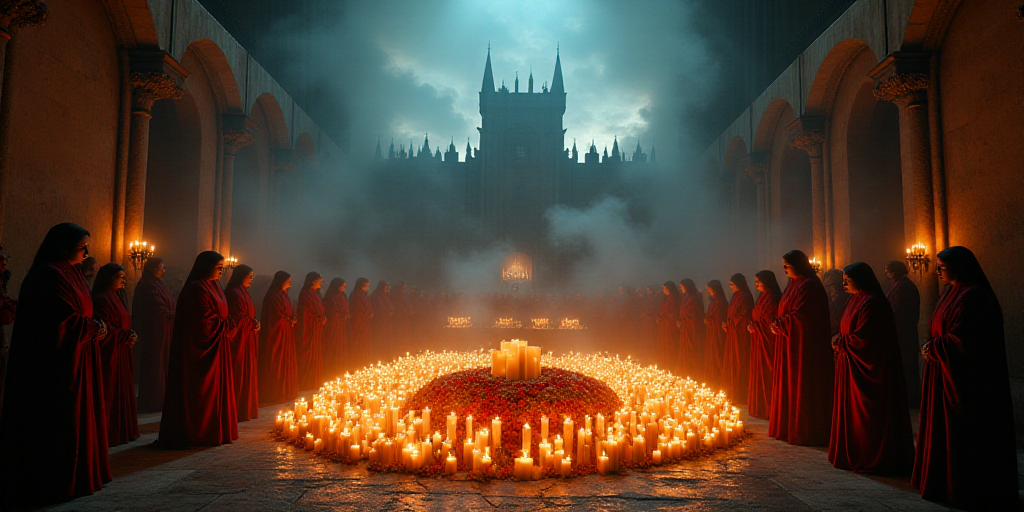
The Pain of Loss: Restructuring Meaning After Death
Loss does not just wound; it disrupts the world. After a death, not only does a person vanish, but also the network of gestures and meanings that sustained life. Grieving is the process that attempts to regain sense.
For decades, cultural psychology has shown that grieving is not about “overcoming,” but rebuilding. Instead of closing the bond, many cultures seek to continue conversations with the deceased, keeping them present in narratives and objects. Cultural mediations – a tomb, a photo, a song, a digital profile – are the bridges that allow one to remain connected with what is absent, rebuilding history from the rupture.
Diverse Ways of Accompanying the Dead
The world is full of languages for grieving. In Madagascar, families celebrate the “famadihana” or “turning of the bones,” a festive reunion where ancestors’ bodies are moved, their shrouds are changed, and they are danced with.

Celebration of the famadihana in Antsirabe (Madagascar). Vladislav Belchenko/Shutterstock
In Japan, many families keep a small Buddhist altar at home called a butsudan, with tablets of their ancestors – the ihai are placed on the altar with the deceased’s name and date of death. Flowers or incense are offered to keep their presence alive.

A butsudan in Goshogawara (Japan). Wikimedia Commons, CC BY
In Ghana, funerals can last days and gather hundreds of people; coffins are carved into symbolic shapes – a fish, a tool – representing the history or occupation of the deceased.
In Mexico, the Day of the Dead celebrates the symbolic return of the deceased to the world of the living. Altars are raised in homes and cemeteries with flowers, bread, candles, and personal items while families gather amidst music, food, and literary calaveras that humorously converse with death.
Among Quechua and Aymara communities in the Andes, death is understood as returning to the territory. Bodies are entrusted to the earth or water that bore them, as the bond between a person and their landscape transforms. Colonial cosmologies, silenced by colonization, remind us that dying can also be returning to the fabric that sustains us.
These practices demonstrate something essential: there is no single way to mourn. Each culture has invented tools to transform absence into relationship and memory into care.
Europe and the Loss of the Language of Grieving
In much of Europe, grieving has become more intimate and less visible. Death often occurs in institutions, away from domestic spaces, and many of the rituals that once accompanied loss have faded.
Discretion has largely replaced collective forms of farewell. In Spain, as in other European countries, it’s still difficult to discuss grieving and death without discomfort. Initiatives like the Vida al final de la vida festival invite citizens to participate in artistic activities and open conversations about it.
Thinking about grieving from a decolonial perspective also involves recognizing that not all deaths weigh the same, nor have all cultures had equal rights to elaborate them.
Colonial narratives of displacement, racism, or structural violence have generated unacknowledged grief: forced migrations, disappeared persons, entire communities deprived of their rituals.
Colonial modernity not only managed bodies but also deaths, deciding which were worthy of mourning and which could be forgotten. In response, many communities have made grieving a form of resistance.
Mothers marching with photos of their disappeared children or improvised altars at borders embody an affective practice that does not seek to close the wound but sustain it collectively, acknowledging the violence that produced it and regaining the capacity to care beyond the colonial framework.
New Mediations, Old Memories
In the 21st century, grieving has also moved to digital spaces. Social networks host memorials, profiles where the living continue writing to the dead, and so-called deathbots – programs that reproduce a deceased person’s voice or messages – extend these conversations beyond life.
Screens, rituals, bodies, and landscapes all mediate continuity between life and death. In this diversity of mediations – ancestral or technological – lies the same need: to keep talking with what is absent, even if the language changes.
Looking at grieving through a cultural and colonial wound lens does not mean idealizing other practices but remembering that mourning is also an act of knowledge and justice.
Each culture embodies a relationship with time and memory, and all recognize that shared pain reconstructs community. In a world accelerating forgetting, grieving can be a form of resistance: a practice that returns slowness, connection, and meaning to life.
In the ways each society accompanies loss, its idea of life, justice, and world is revealed. Grieving, far from being a soul’s illness, is a mediation between memory and future, between absence and the continuity of life.




