
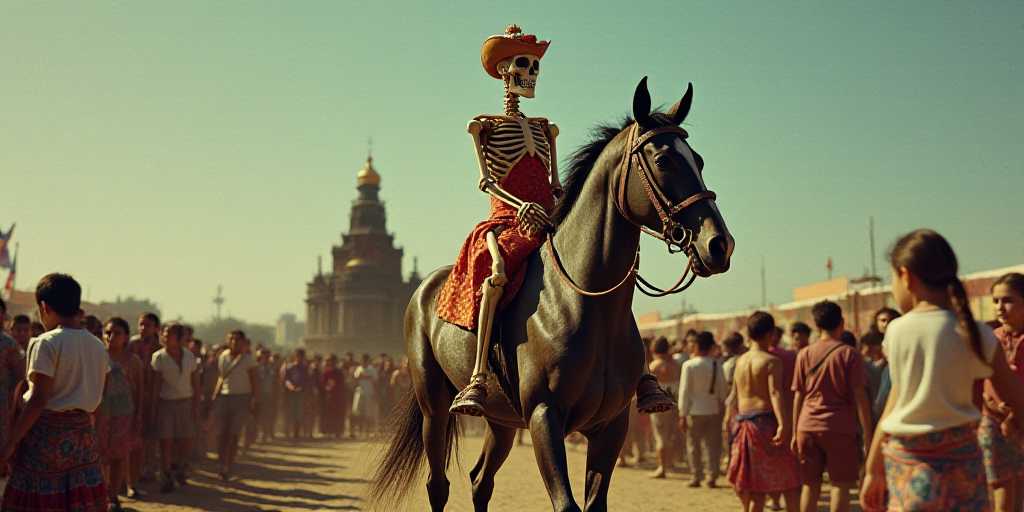
The Cultural Spectacle
Day of the Dead, a tradition that has undergone decades of transformation, now represents Mexico’s most emblematic cultural expression. However, these changes have accelerated in recent years due to the presence of this celebration on social media, where it is projected as a visual spectacle.
On TikTok, Instagram, and YouTube, altars and catrinas are depicted with Halloween costumes and viral challenges, blending the sacred and festive with the viral.
The Patrimonial Show
Being included in UNESCO’s Intangible Cultural Heritage list in 2008 has turned Day of the Dead into a symbol of Mexican heritage, boosted by cultural and tourism policies.
The Mexico City parade, inspired by the James Bond film Spectre (2015), moved the celebration from domestic to public spaces. This is complemented by fairs, festivals, and tourist routes promoting the “Day of the Dead experience” as a cultural product.
From Indigenous Tradition to Pop Culture
Day of the Dead is a blend of Mesoamerican ancestor worship practices and Spanish/Catholic All Saints’ Day commemorations, creating a deeply identity-driven celebration.
Currently, another wave of syncretism is underway. The fusion of indigenous heritage and global pop culture is evident on TikTok, where traditional offerings incorporate pumpkins, LED lights, or costumes inspired by movies like Coco (Pixar/Disney, 2017).
This phenomenon can be understood through the lens of “hybrid cultures,” a concept introduced by Argentine-Mexican anthropologist Néstor García Canclini. In line with this idea, these cultural expressions are not mere imitations of the foreign but reappropriations where global symbols are reinterpreted. Thus, traditional alters with candles and papel picado coexist with digital filters, demonstrating that cultural identities transform rather than disappear.
Media Globalization and Symbolic Consumption
The influence of media and market forces has also shaped the current resignification. A clear example is Victoria beer’s campaign, which for years has created short films, products, and advertisements inspired by pre-Hispanic underworld myths.
In a recent viral video, the brewery mixes the underworld mitology of Mictlán with the modern history of Victoria beer, producing a discourse that unites the ancestral with the commercial. In other words, identity with modernity.
These strategies include Victoria beers with cempasúchil (the traditional Day of the Dead flower) flavors, narratives of “Mexican pride,” and collaborations with artists like dancer Isaac Hernández.
Their implementation through marketing and advertising reveals how cultural identity becomes a brand’s experiential language. However, it also shows that companies rely on symbols like Day of the Dead not just to sell but to emotionally reconnect the audience with their culture and the product through consumption.
In this way, the patrimonialization of Day of the Dead, driven by tourism and social media, functions as a societal mirror where both identity pride and commercial appropriation of the sacred are expressed.
From White Altars to Identity-Driven Meximalism and Tropicalization
A recent debate visible on TikTok is the so-called “white altars” or “minimalist altars.” Some videos show how contemporary design trends, marked by neutral tastes and catalog aesthetics, have transferred to the altar tradition. In these, cempasúchil flowers are replaced with white arrangements, colored candles with cool lights, and personal items of the deceased with decorative elements.
This phenomenon, beyond aesthetic preference, raises an identity question. The Mexican altar does not follow the “less is more” principle but operates under a meximalism logic, where “more is more”: colors, aromas, textures, and symbols that tell a living story. Facing global design homogenization, the traditional altar acts as a symbolic resistance, making it not just a decorative trend but a way to reaffirm Mexican collective history and the affective bonds that sustain Mexican identity.
Other viral content shows how Mexican culture reclaims its identity by reviving Day of the Dead over Halloween tradition. Catrinas regain prominence over zombies or Anglo monsters, a process of tropicalization. A sort of festive blend where the local strengthens by dialoguing with the global.
Unlike the 80s and 90s when Halloween gained ground as a representation of modernity and foreignness, today Day of the Dead is lived with pride and creativity.
However, it’s worth asking if this revival is sustained communally or through spectacle. Movies like Coco or Spectre, or events such as the “Day of the Dead cycling parade,” where lights are lit and costumes worn, can simultaneously be mechanisms of dissemination and superficialization of the rite. In this way, the line between tradition and performance becomes increasingly blurred.
It is in this blend of altar and digital filter, catrina and pop lens, market and memory where contemporary Mexican identity’s expression is found, engaging with the world without losing its roots. Because, like any tradition, Day of the Dead is not preserved but lived.




