
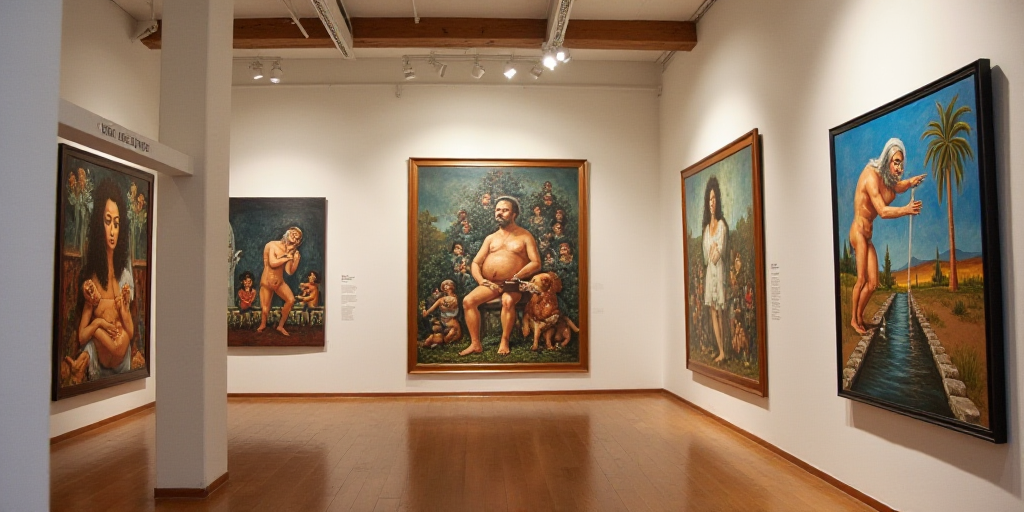
A Unique Program in Mexico
The Licenciatura en Historia del Arte y Curaduría at the Universidad de las Américas Puebla (UDLAP) stands out among the innovative and critical educational proposals in visual arts, recently undergoing academic and critical renewal within humanities. Dr. Yalicel Gabeira López, the program’s coordinator, highlights its foundations, approaches, and key features that set it apart as a unique program in Mexico.
A Program with Over 30 Years of History
Dr. Gabeira López emphasizes that this degree has a long-standing history within UDLAP. The curriculum has been consistently revised to address new challenges in the discipline and transformations within the artistic field. What distinguishes this program is its critical stance against traditional approaches to art history.
Decolonizing Perspective: A Critical and Plural Art History
One of the program’s most notable strengths is its commitment to challenging the dominant, Eurocentric, and patriarchal perspectives that have historically characterized art history. Dr. Gabeira López explains that the curriculum is designed to broaden traditional perspectives and provide space for underrepresented artistic contexts, such as Latin America, the Caribbean, and other non-Western areas.
- Courses: Examples include “Art and Gender,” “Latin American Art,” “African Art,” and “Postcolonial Studies.” These courses open new avenues for analysis and enable students to think from alternative epistemologies.
- Interdisciplinary Approaches: The program integrates approaches from sociology, psychoanalysis, philosophy, and anthropology, thereby expanding theoretical tools for understanding artistic processes.
Thematic Axes Balancing Theory and Practice
The curriculum is structured around various axes that balance theoretical formation with practical preparation. Key axes include:
- Universal Art Axis: This axis covers early artistic expressions to contemporary art, including medieval, Renaissance, Baroque, modern, and regional world art.
- Theoretical-Critical Axis: This axis covers fundamental subjects like “History of Aesthetic Ideas,” “Art and Critical Thinking,” “Gender Studies in Art,” and “Contemporary Art Theory.” These courses provide students with a solid framework for reflecting and critically analyzing art and its discourses.
- Mexico Studies Axis: This axis covers pre-Hispanic art to 20th-century Mexican art, enabling an understanding of the country’s artistic development in dialogue with the Latin American context.
Curatorship as a Critical and Professional Practice
A notable feature of this degree is its focus on curatorship, explicitly included in the program’s name. Students take specific courses like “Curatorship,” “Cultural Management,” “History and Evolution of Museums,” “Art Criticism Workshop,” “Cultural Heritage,” and a particularly practical course called “Curatorial Clinic.” In this last course, students design and mount a real exhibition under the guidance of specialized academics.
Interdisciplinarity and Professionalization
Beyond disciplinary content, the program encourages cross-disciplinary engagement. Courses on image, cinema, photography, visual technologies, and design broaden the professional horizons of art history students. The curriculum also includes selected topics, allowing for inviting national and international experts to deliver specialized seminars, keeping the curriculum current and flexible.
Forming Critical Thinkers and Cultural Project Leaders
Dr. Gabeira López concludes by stating that the program’s ultimate goal is to form reflective, ethical, and committed professionals in art production, interpretation, and dissemination across its various dimensions. The Licenciatura en Historia del Arte y Curaduría de la UDLAP is thus presented as a comprehensive formative option, with a critical view of the past, sharp understanding of the present, and transformative projection towards the future of art.




