
Introduction
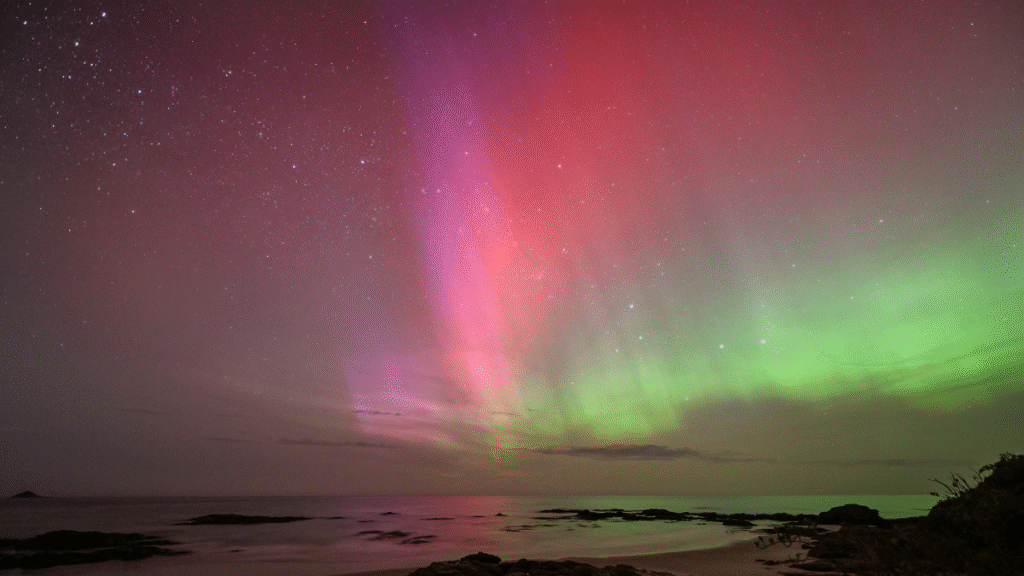
A spectacular display of auroras is expected to be visible at unusually low latitudes from Wednesday night through Thursday, resulting from intense solar activity that also poses risks to communication networks.
The Solar Storm and Its Impact
This rare event, which could be seen in the skies over New Zealand and Australia on Wednesday night, is caused by massive ejections of solar particles known as coronal mass ejections (CME). When these CMEs reach Earth, they trigger geomagnetic storms.
According to the National Oceanic and Atmospheric Administration (NOAA) in the United States, a level 4 out of 5 geomagnetic storm occurred on Tuesday, and another CME could lead to a repeat on Thursday.
On Tuesday night, Mexico’s skies were illuminated with faint pink and green glows, a delight for many who would typically need to travel closer to the poles to witness this phenomenon.
Last year, a level 5 geomagnetic storm occurred for the first time in two decades, resulting in equally impressive views.
Risks and Consequences
Beyond the breathtaking light shows, strong solar storms can also disrupt communication systems and cause satellite malfunctions. They may overload electrical grids, posing additional risks.
Impact on Space Industry
Due to the risks associated with this week’s solar event, Jeff Bezos’ space company, Blue Origin, was forced to postpone the launch of its New Glenn rocket again on Wednesday.
Viewing the Auroras
For those eager to witness the auroras, it is advised to seek darker skies away from city lights and carry a camera or smartphone. These devices can capture the lights in long-exposure photos if they aren’t visible to the naked eye.
Key Questions and Answers
- What is causing the stunning auroras? Intense solar activity, specifically coronal mass ejections (CME), is triggering geomagnetic storms that result in the visible auroras at unusually low latitudes.
- Who is affected by this solar storm? While the public gets to enjoy a rare display of auroras, communication systems and satellites are at risk due to potential disruptions caused by the storm.
- What is the impact on the space industry? The solar storm has forced Jeff Bezos’ Blue Origin to postpone the launch of their New Glenn rocket, highlighting the risks associated with solar events for space missions.
- How can one view the auroras? To observe the auroras, find darker skies away from city lights and use a camera or smartphone to capture the light displays in long-exposure photos.




