
A Unique Bond Between Religion and Sports in Mexico
In January 1957, José Garibi Rivera, the Archbishop of Guadalajara and a representative from the Vatican, welcomed the players of the Club Deportivo Guadalajara’s football team, known as “las Chivas,” after their triumph in winning the league by defeating Irapuato, thanks to a header goal from legendary striker Chava Reyes.
The Faith that Unites Millions
Mexico is a country where passions run deep. Two of the most intense are devotion to the Virgin of Guadalupe and love for Club Deportivo Guadalajara, known as “las Chivas.” On the surface, these appear to be separate realms: one religious and the other sports-related. However, upon closer inspection, it becomes clear that they share symbols, emotions, and a profound connection to Mexican identity.
Every December 12th, millions of people flock to the Basilica of Guadalupe in Mexico City, young and old, families and individuals alike, to pay tribute to Mexico’s patron saint. This date transforms the country into a mosaic of faith, with chants, prayers, and “mañanitas” (happy birthday) echoing across Mexico.

Millions of devotees of the Virgin of Guadalupe head to her Basilica on December 12th.
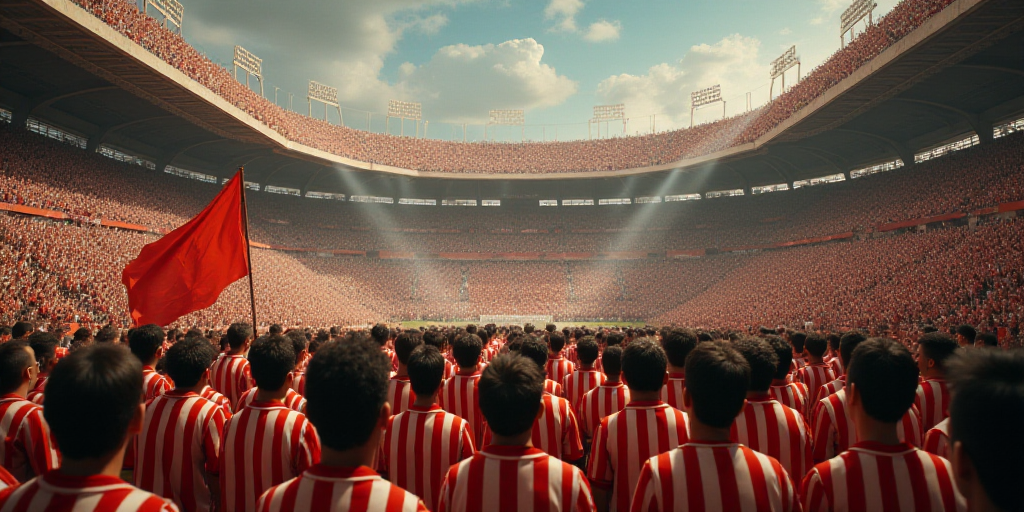
A similar atmosphere unfolds when “las Chivas” take the field, whether live at the Akron Stadium or watching from home. The colors red, white, and blue evoke the same emotional intensity as the Virgin’s mantle. Fans sing, cheer for goals, and sometimes entrust the outcome to the “Morenita del Tepeyac.”
Rituals that Stir Emotions
The religious fervor surrounding the Virgin of Guadalupe and the passion for “las Chivas” share a common thread: rituals. Candles, rosaries, and altars are present in one realm; team shirts, flags, and chanting groups (animación porras) in the other. Both spaces—temple and stadium—transform individual experiences into collective ones, uniting people in shared joy, sorrow, and hope.
Recent studies show that fans feel pride not only for titles but also for the values embodied by their team. Since its inception, “las Chivas” have only played with Mexican players, akin to the Athletic Club of Bilbao in Spain, which only includes players from the Basque region.
The strong national accent of “las Chivas” alignments connects with the values associated with the Guadalupean marian imagery. Few Mexicans feel detached from these popular expressions, which serve as unifying forces for nationalism.
This convergence traces its roots to Archbishop Garibi Rivera’s blessing and the “rebaño sagrado” (sacred flock) baptism. The religious connection to the football club has been maintained and strengthened in Guadalajara and throughout Mexico, with Pope Pio XII himself blessing “las Chivas” at the cardinal’s request.
Mexican Pride Beyond Borders
The Guadalupean devotion also adapts to local cultures. In some indigenous regions, rituals blend Catholic elements with local traditions, reinforcing cultural identity. This connection explains why one can see the Virgin and the rojiblanco shield together in murals and stands, representing pride and belonging.
The “duoteísmo” uniting the Virgin of Guadalupe and “las Chivas” extends beyond Mexico. Millions of migrants in the United States carry images and rojiblanco shirts, preserving their Mexican identity despite distance.
A Culture of Shared Emotions
One distinctive aspect of Mexican culture is experiencing emotions communally, whether in the Basilica or the stadium. Chants, tears, and cheers amplify in these settings. The Virgin of Guadalupe and “las Chivas” act as catalysts for identity, allowing individuals to recognize themselves, feel accompanied, and strengthen a sense of belonging.
According to Los Angeles Times, the Virgin also symbolizes cultural resistance and indigenous memory. A trait shared by “las Chivas,” which in turn inspires a sense of rooted nationalism.
Approaching the 2026 World Cup
As preparations begin for the 2026 World Cup, Mexico is already buzzing with festive anticipation. For this third hosting opportunity (Mexico previously served as host in 1970 and 1986), Guadalajara is gearing up to welcome thousands of fans and tourists.
Tapatíos (residents of Guadalajara) and jaliscienses (natives of Jalisco) will temporarily become gracious hosts to visitors from around the globe. To accommodate them, local and state authorities have announced significant improvements to visitor services and infrastructure.
Just as crucial as these developments will be the roles played by Guadalupean devotion and local fans’ colors. These expressions of popular culture and deeply rooted Mexican faith serve as distinctive markers that will accompany both visitors and hosts, uniting them in a joyous celebration.
The religious-football connection will be even more prominent in Mexico City, where both the “cathedral” of Mexican football (Estadio Azteca) and the Basilica of Guadalupe coexist within the same geographical space.
The Sacred Passion Beating in the Heart of Mexico
Though the Virgin of Guadalupe and “las Chivas” inhabit separate worlds, they intertwine in the Mexican heart. Both embody faith in the impossible, hope amidst adversity, and the need for symbols that give meaning to collective experiences.
Amidst prayers and goals, the Mexican culture thrives with equal intensity. For millions, carrying both the Virgin and “las Chivas” in their hearts is more than a custom; it’s a way of being Mexican, celebrating identity, and sharing emotions that transcend generations and borders.




