
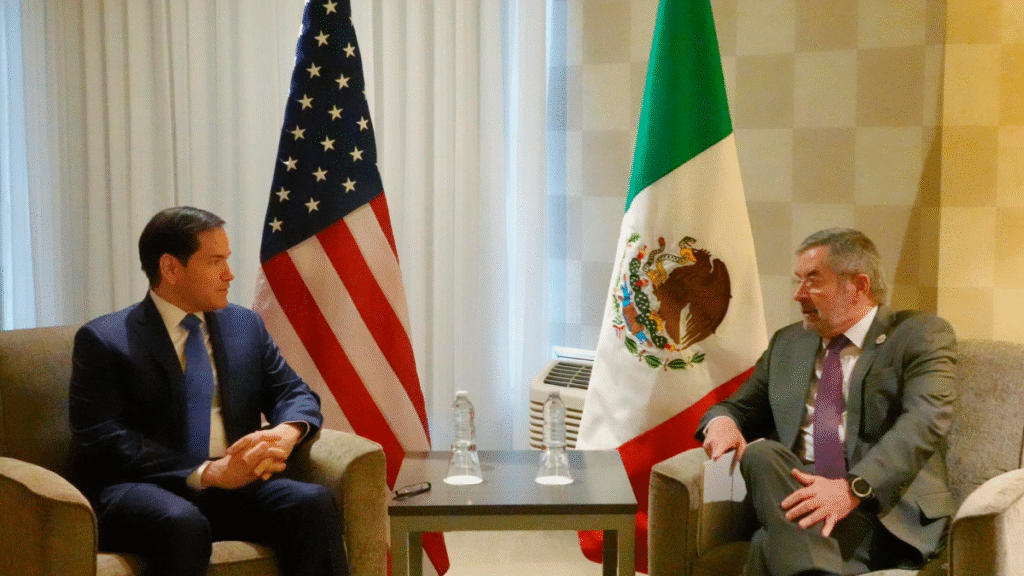
Background on Marco Rubio and His Relevance
Marco Rubio, a United States Senator from Florida and former Speaker of the Florida House of Representatives, has been a prominent figure in American politics. As the Secretary of State of the United States, his words carry significant weight and influence policy discussions both domestically and internationally. His recent statements about Mexico’s drug cartels highlight the complex relationship between the two nations and the ongoing challenges in combating transnational organized crime.
Rubio’s Stance on Military Support to Mexico
No Unilateral Military Deployment:
Marco Rubio clarified that the United States will not send military forces to Mexico unilaterally. However, he emphasized that the U.S. is willing to provide training, equipment, and intelligence support if requested by the Mexican government.
“We can help with equipment, training, intelligence exchange, and many other things. But they would have to ask for it,” stated Rubio, the U.S. federal official.
Cartels as Transnational Criminal Organizations
Comparing Cartels to Terrorist Groups:
Rubio warned that Mexican drug cartels and other criminal groups in Latin America operate similarly to “transnational criminal organizations,” despite not being driven by political or religious ideologies.
He pointed out that these groups possess more weapons, better training, and greater operational capabilities than some national security forces. Additionally, their structures surpass the security capacities of various countries in the Western Hemisphere.
“Just because they’re not driven by an ideology doesn’t mean they aren’t terrorists. In many cases, they have more weapons, better training, better intelligence, and more capabilities than some nation-states,” Rubio asserted.
The senator highlighted that in certain Mexican regions, criminal cartels exert territorial control and outperform local police forces and even national security forces.
Moreover, Rubio emphasized that the issue of criminal group expansion is not exclusive to Mexico. He mentioned that in Ecuador, these organizations pose a direct threat to the state, while in Haiti, armed gangs have greater capabilities than the country’s own security institutions.
Collaboration with Mexico
Mexico’s Coordination Protocol:
Mexico’s President, Claudia Sheinbaum, confirmed the existence of a permanent coordination protocol with U.S. authorities regarding attacks on alleged criminal vessels.
Sheinbaum Pardo explained that the Mexican Navy leads these actions and receives any information from U.S. agencies or the U.S. Southern Command to ensure that Mexican authorities conduct appropriate interceptions.
According to Sheinbaum Pardo, the first agreement reached in the bilateral working table is the maintenance of compliance with international treaties that prohibit practices such as bombing vessels.
Key Questions and Answers
- Q: Will the U.S. send military forces to Mexico? A: No, the U.S. will not deploy military forces unilaterally to Mexico, as stated by Marco Rubio. However, they are willing to provide training, equipment, and intelligence support if Mexico requests it.
- Q: How do drug cartels in Mexico compare to terrorist organizations? A: According to Rubio, Mexican drug cartels function similarly to transnational criminal organizations, possessing more weapons, better training, and greater capabilities than some national security forces. Although not driven by political or religious ideologies, their actions resemble those of terrorist groups.
- Q: What is the current collaboration between the U.S. and Mexico regarding criminal activities? A: There is a permanent coordination protocol between the U.S. and Mexico to address criminal activities, particularly attacks on alleged criminal vessels. The Mexican Navy leads these efforts, receiving information from U.S. agencies to ensure appropriate interceptions.




