
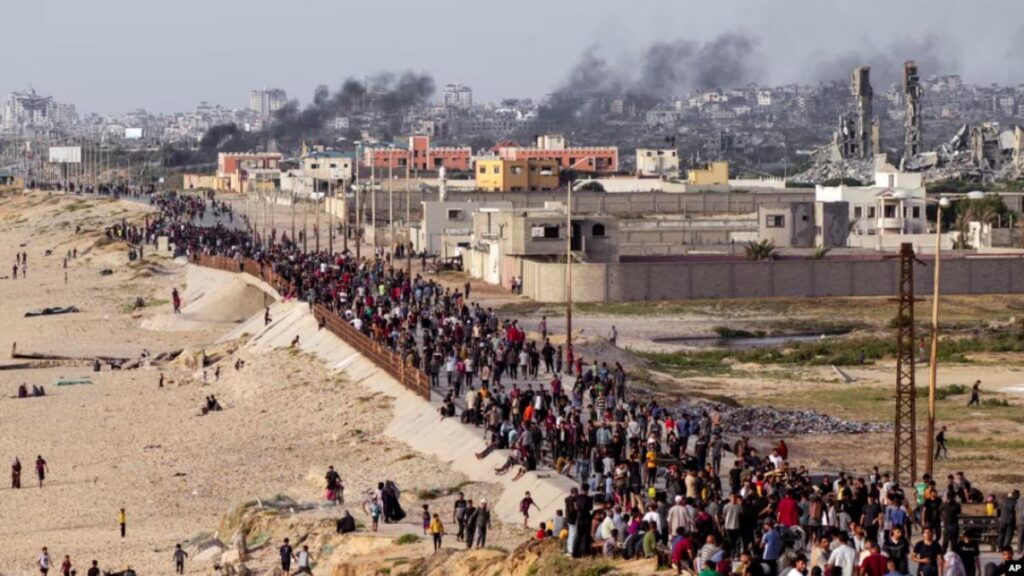
Background on Key Figures and Organizations
The recent announcement by Israel to open a permanent border crossing for humanitarian aid in northern Gaza has sparked discussions about the potential impact on the region’s residents. This move comes as a collaborative effort between Israel, the United Nations (UN), and other international organizations to address the ongoing humanitarian crisis in Gaza.
Who is involved?
- Israel: A country in the Middle East, bordering Lebanon to the north, Syria to the northeast, Jordan on the east, and Egypt to the southwest. It has been a central player in the Israeli-Palestinian conflict.
- United Nations (UN): An international organization founded in 1945, composed of most world’s countries as members. The UN aims to promote peace, security, and cooperation among nations.
- Other international organizations: Various humanitarian agencies, such as the World Food Programme (WFP), UNICEF, and the International Committee of the Red Cross (ICRC), work together to provide aid and support in conflict zones.
Why is this relevant?
Gaza has been under a blockade imposed by Israel and Egypt since 2007, which has severely restricted the movement of people and goods in and out of the territory. This blockade has exacerbated a humanitarian crisis, with high rates of unemployment, poverty, and limited access to essential services like healthcare and education.
Details of the Announcement
On Wednesday, Israel announced the opening of a permanent border crossing in northern Gaza to facilitate the entry of humanitarian aid provided by the UN and other international organizations. This decision aims to alleviate some of the suffering caused by the prolonged blockade and address critical needs in Gaza.
What does this mean for Gaza?
- Improved access to essential supplies: Humanitarian aid will now have a more straightforward path into Gaza, potentially increasing the availability of food, medicine, and other vital resources.
- Economic opportunities: Easing restrictions on goods and people may encourage limited trade and economic activities, offering some relief to Gaza’s struggling economy.
- Political implications: This move could signal a shift in Israel’s approach towards Gaza, potentially fostering a more cooperative relationship between the two entities.
Key Questions and Answers
- Question: What is the purpose of this new border crossing?
- Question: Who is responsible for providing the aid?
- Question: How will this impact the daily lives of Gaza residents?
- Question: Are there any concerns or challenges associated with this new crossing?
Answer: The primary goal is to streamline the delivery of humanitarian aid, including food, medicine, and other essential supplies, to the residents of Gaza.
Answer: The United Nations and various international organizations, such as the World Food Programme (WFP), UNICEF, and the International Committee of the Red Cross (ICRC), will be responsible for delivering aid through this new crossing.
Answer: Residents may experience improved access to essential supplies, potential economic opportunities, and a possible shift in the political climate between Israel and Gaza.
Answer: While the announcement is positive, there may be logistical challenges in coordinating aid delivery and ensuring that the new crossing remains open and functional. Additionally, skepticism may exist regarding Israel’s long-term commitment to this policy change.




