
Introduction
In a city generating 12,454 tons of waste daily, with over half ending up in landfills and 13% in illegal dumpsites, a new effort aims to demonstrate that climate action can also be built from the ground up through neighborhoods and community networks.
The “Pacto con la Tierra” Program
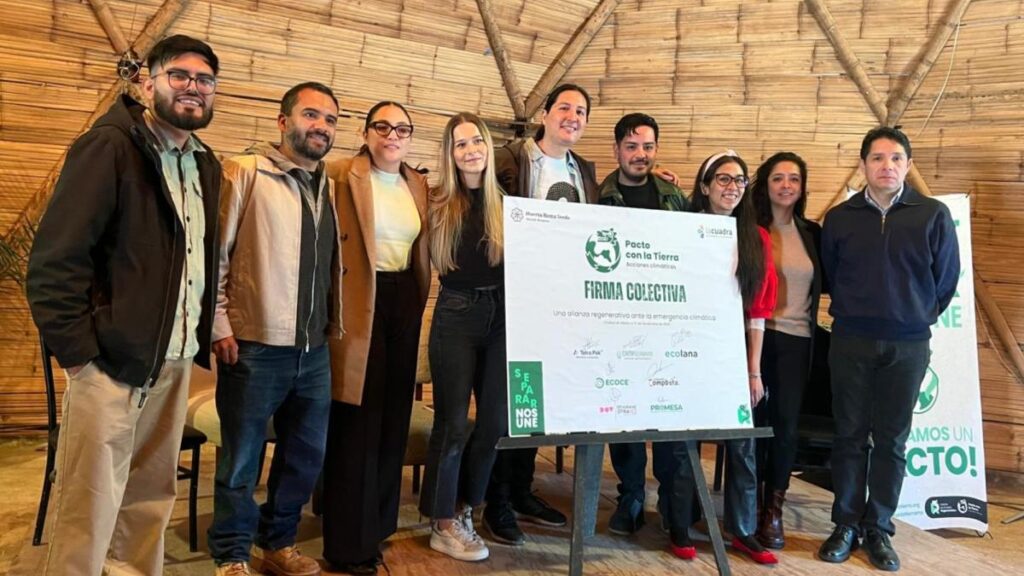
Led by Huerto Roma Verde, La Cuadra A.C., and a coalition of organizations promoting circular economy at the community level, including ECOCE, Tetra Pak México, Ecolana, Hagamos Composta, PROMESA, and SUEMA, the program targets over 30 types of waste, including those with little value or collection infrastructure.
Objective
The goal is to transform discarded materials into resources that regenerate soils, produce compost, recover packaging, and generate community assets.
Neighborhood-Level Climate Action
“Pacto con la Tierra” aims to address more than 95% of domestic waste, integrating organic waste (50% of total) and a wide range of recyclable materials. The approach combines responsible collection, environmental education, social innovation, and traceability to show that climate action can start at the most local level: the neighborhood.
Collaboration with ECOCE and Tetra Pak Mexico
ECOCE and Tetra Pak Mexico’s participation is crucial in strengthening specialized collection centers for complex materials like flexible plastics and beverage cartons, which make up a significant portion of Mexico’s waste but often end up in landfills or dumpsites due to lack of proper processing.
“This agreement marks a significant step towards the circularity of flexible plastics. We aim to prove that these materials’ cycle can be closed through community spaces,” said Adrián Velasco, Director of Flexible Plastics Packaging at ECOCE.
“Sustainability must be built with transparency and citizen participation,” emphasized Jorge Terrazas Ornelas, General Director of ECOCE. “Waste can be transformed into environmental and social opportunities.”
Super-Recycling and Urban Regeneration
Beyond traditional recycling, the initiative pushes for super-recycling—transforming materials into higher-value products like urban furniture, environmental equipment, school supplies, or household items. The aim is to show that trash can become community infrastructure and promote a circular economy with social impact.
Strengthening Huerto Roma Verde
To achieve this, the project will enhance Huerto Roma Verde’s composting facilities, material receiving capabilities, and nurseries. It will also expand collection capacity alongside Ecolana, Hagamos Composta, and PROMESA, and deploy an Education and Ecological Action Program to engage residents in waste separation and delivery.
“We want to inspire more urban spaces to join this regenerative community and environmental responsibility network,” expressed Francisco Ayala, founder of Huerto Roma Verde.
Traceability and Citizen Rewards
An innovative aspect of the model is that citizens will know the carbon footprint avoided for each material handed over at the collection center. Moreover, a rewards system will allow people to exchange waste for vegetables, plants, compost, workshops, and Huerto Roma Verde products.
The pilot program will start this month, with the formal registration and traceability system launching in January 2026.
A Local Response to a Global Issue
Industry data shows Mexico generates over 7 million tons of plastic waste annually, with 40% being flexible packaging—one of the hardest materials to recover. Alfredo Román, Sustainability Manager at Tetra Pak Mexico, stressed the importance of building inclusive and collaborative value chains: “We’ve adopted an open approach to partnerships and work with a broad range of allies to expand infrastructure and improve the value of recycled materials.”
Together, the initiative strives to become a replicable model linking climate action, circular economy, urban regeneration, and social participation. As Piero Barandiarán, Director of Projects at Huerto Roma Verde, stated, “The program aims to address waste-related pollution at the neighborhood level while fostering social cohesion and environmental revitalization.”
Key Questions and Answers
- What is “Pacto con la Tierra”? It’s a community-level waste management program led by Huerto Roma Verde and other organizations to tackle various types of waste, transforming them into resources for the community.
- Who are the key partners? Huerto Roma Verde, La Cuadra A.C., ECOCE, Tetra Pak México, Ecolana, Hagamos Composta, PROMESA, and SUEMA.
- What materials does the program target? Over 30 types of waste, including complex materials like flexible plastics and beverage cartons.
- What is the ultimate goal? To create a circular economy, regenerate soils, produce compost, recover packaging, and generate community assets.
- When will the program start? The pilot program begins this month, with the formal registration and traceability system launching in January 2026.




