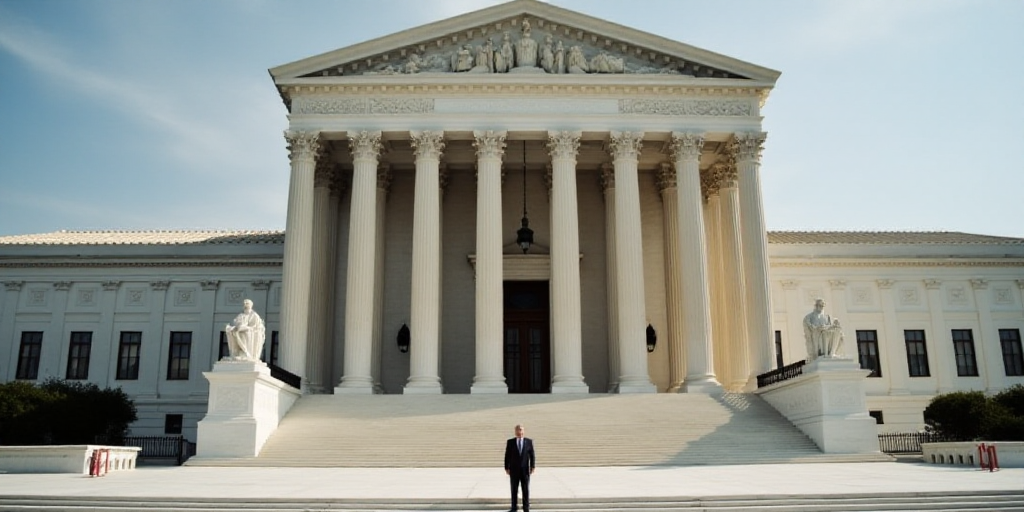
Background on Donald Trump and His Trade Agenda
Donald Trump, the former President of the United States, has been a significant figure in American politics since his inauguration in January 2017. Known for his controversial policies and business acumen, Trump’s trade agenda has been a focal point of his presidency. As he leaves office, the Supreme Court is now deliberating on the legality of tariffs he imposed on numerous trading partners.
The Case Against Trump’s Tariffs
At the heart of the matter is whether the President’s emergency powers grant Trump the authority to impose tariffs on almost all of his trading partners. Critics argue that the International Emergency Economic Powers Act (IEEPA) does not permit such extensive tariff measures.
- Opposition Arguments: The opposing side contends that the IEEPA does not extend to imposing tariffs, as it only mentions presidential powers to “regulate imports and exports.”
- Key Legal Doctrine: A crucial aspect of the debate revolves around the “important questions doctrine,” which asserts that Congress must authorize a president to implement far-reaching measures.
Government’s Defense of Tariffs
Solicitor General John Sauer, representing the government, argued that the important questions doctrine does not apply due to the broad inherent powers associated with the presidency. He also warned that invalidating tariffs could expose the US to “relentless retaliatory trade measures” from other countries.
Sauer emphasized that the core issue is not tariff imposition but rather regulation of foreign trade.
Supreme Court Justices’ Perspectives
During the proceedings, several justices expressed uncertainty regarding the extent of authority granted to Trump through IEEPA invocation. The law only mentions presidential powers to “regulate imports and exports,” not imposing tariffs.
- Progressive Judge Sonia Sotomayor: “Tariffs are the responsibility of the legislative branch… and tariffs are taxes.”
Conservative Judge John Roberts noted that Trump uses IEEPA “to impose tariffs independently of the product and country of origin, selecting the amount and duration,” thereby granting “significant authority” to the president.
Trump’s Tariff History and Legal Challenges
Since returning to the White House, Trump has imposed tariffs on a wide range of goods, raising them to their highest levels since the 1930s. A lower court ruled in May that Trump had exceeded his authority in imposing tariffs, but the government’s appeal allowed them to remain temporarily in effect.
In August, a federal appeals court ruled the tariffs were illegal, prompting the government to elevate the case to the Supreme Court.
Trump asserted ahead of the Supreme Court session that maintaining these tariffs is “a matter of life or death for” the United States. Even if the Supreme Court deems all tariffs illegal, the Trump administration could potentially invoke other laws to impose a 15% tariff for 150 days, using that window to initiate official investigations under Section 301 of the Trade Act.
Key Questions and Answers
- What is the central issue being debated by the Supreme Court? The court is determining whether President Trump’s emergency powers grant him the authority to impose tariffs on almost all trading partners.
- What arguments does the opposition present against Trump’s tariffs? Critics argue that the International Emergency Economic Powers Act (IEEPA) does not permit such extensive tariff measures, as it only mentions presidential powers to “regulate imports and exports.”
- What defense does the government provide for Trump’s tariffs? Solicitor General John Sauer contends that the important questions doctrine does not apply due to the broad inherent powers associated with the presidency and warns of potential retaliatory trade measures from other countries if tariffs are invalidated.
- How have lower courts ruled on Trump’s tariffs? A lower court ruled in May that Trump had exceeded his authority, but the government’s appeal allowed tariffs to remain temporarily in effect. A federal appeals court later ruled the tariffs were illegal, leading to the Supreme Court case.